
Siena › About the city
This is Siena
Siena lies on three hills in the middle of Tuscany, between the vineyards of Chianti and the bare clay hills of the Crete Senesi. For three centuries it was a free republic, a banking town that rivalled Florence, and it has kept its Gothic centre of brick almost as it was in the 14th century, round the shell of the Piazza del Campo. Twice every summer its seventeen contrade race the Palio there.
Photo: Andrzej Otrębski, CC BY-SA 4.0, via Wikimedia Commons

Siena at a glance
- Country
- Italy
- Region
- Tuscany
- Province
- Siena, of which it is the capital
- Population
- About 53,000 (city)
- Height
- About 320 metres above the sea
- Districts
- Three terzi (Città, San Martino and Camollia) and seventeen contrade
- Patron saints
- The Virgin Mary, and Saint Catherine of Siena
- World Heritage
- The historic centre, since 1995
Known for
- The Piazza del Campo, the shell-shaped square at its heart
- The Palio, the horse race round the Campo on 2 July and 16 August
- The Torre del Mangia and the Palazzo Pubblico, with Lorenzetti’s frescoes of good and bad government
- The striped cathedral with its floor of marble pictures
- The Monte dei Paschi, the oldest bank in the world still in business
- Panforte and ricciarelli
The city
Siena’s centre lies on three ridges that meet at a hollow, and the Piazza del Campo fills that hollow. From it the three main streets, Banchi di Sopra, Banchi di Sotto and Via di Città, climb along the ridges to the three thirds of the town, the terzi, and between them steep lanes and stairs drop into the valleys. Almost everything is built of the same brick, in the reddish brown of the earth round Siena that gave the paint colour burnt sienna its name.
Instant Siena takes you through the heart of it: down Banchi di Sopra to the Loggia della Mercanzia, into the Campo below the Torre del Mangia, up the Casato to the cathedral and Santa Maria della Scala, and back past the Baptistery and along Via delle Terme. The centre has been closed to cars since the 1960s. The real town climbs and falls on every street, but the game keeps it flat.
Where it lies
Siena is the capital of its province in the south of Tuscany, about 70 kilometres south of Florence. To the north lie the hills and vineyards of Chianti, to the south-east the bare grey hills of the Crete Senesi and the Val d’Orcia, and to the west the woods of the Montagnola. The Via Francigena, the pilgrims’ road from Canterbury to Rome, runs right through the town.
The town has no river. For its water it dug the bottini, some 25 kilometres of tunnels under the hills that still feed its old fountains. Its summers are hot and dry and its winters cool, with the odd frost and now and then some snow.
Places and landmarks
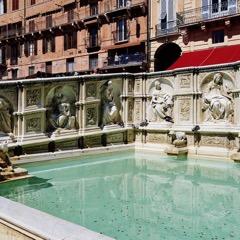 Fonte GaiaThe marble fountain at the top of the Campo, where the water of Siena’s underground aqueducts first reached the square.
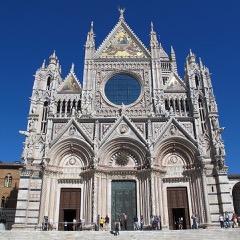 Duomo di SienaThe cathedral on the highest hill of the town, striped in white and dark green marble, with a floor of inlaid marble pictures.
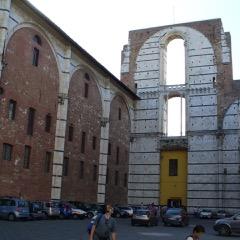 FacciatoneThe bare front of the vast new cathedral that Siena began in 1339 and gave up after the Black Death.
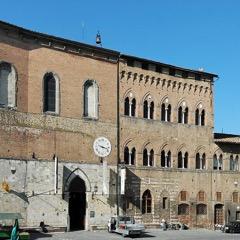 Santa Maria della ScalaOne of the oldest hospitals of Europe, opposite the cathedral, which looked after pilgrims and foundlings for nearly a thousand years.
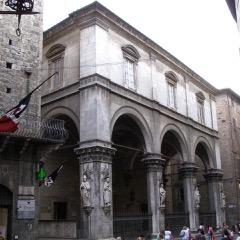 Loggia della MercanziaThe 15th-century loggia of the merchants’ court, at the crossing where Siena’s three main streets meet above the Campo.
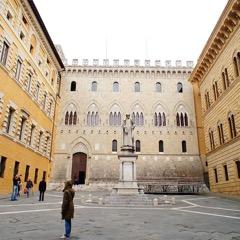 Piazza SalimbeniThe small square of the palaces of the Monte dei Paschi, the oldest bank in the world still in business.
The centre on a map
The streets, squares and waterways every visitor to Siena ends up in. Point at one to find it on the map.

-
1
Piazza del Campo Il Campo square
The shell-shaped square of red brick at the heart of the town, where the Palio is run.
-
2
Palazzo Pubblico building
The Gothic town hall at the foot of the Campo, with the Museo Civico upstairs.
-
3
Torre del Mangia building
The town hall’s brick tower, 88 metres tall, with 400 or so steps to the top.
-
4
Fonte Gaia building
The marble fountain at the top of the Campo, fed by the bottini.
-
5
Loggia della Mercanzia building
The merchants’ loggia where the three main streets meet.
-
6
Banchi di Sopra street
The main street from the Campo to Piazza Salimbeni, full of shops and pastry shops.
-
7
Via di Città street
The street of palaces along the ridge from the Loggia della Mercanzia towards the cathedral.
-
8
Piazza Salimbeni square
The square of the Monte dei Paschi’s palaces.
-
9
Duomo di Siena Cattedrale di Santa Maria Assunta building
The striped marble cathedral on the highest hill.
-
10
Facciatone building
The bare front of the unfinished new cathedral, with the Museo dell’Opera.
-
11
Santa Maria della Scala building
The old pilgrims’ hospital opposite the cathedral, now a museum.
-
12
San Domenico building
The great brick church of Saint Catherine, on its own hill.
-
13
Fontebranda building
The arched medieval fountain in the valley below San Domenico.
-
14
Fortezza Medicea park
The Medici fortress, now a park on its walls.
History
From Saena Julia to a free town
Legend says that Senius, a son of Remus, founded Siena, which is why the she-wolf feeding the twins stands on columns all over the town. The Romans had a small colony here, Saena Julia, but the town only grew in the Middle Ages, as a stop on the Via Francigena.
By the 12th century Siena governed itself as a commune, and its merchants and bankers lent money to popes and kings across Europe. In 1260, at Montaperti, its army beat Florence, the great rival to the north, in one of the bloodiest battles of the time.
The Nine and the Black Death
From 1287 to 1355 the government of the Nine, merchants and bankers, ran the town in its best years. They paved the Campo, built the Palazzo Pubblico and the Torre del Mangia, brought water through the bottini and had Simone Martini and the Lorenzetti brothers paint the town hall. In 1339 they began a cathedral that would outdo Florence’s.
The plague of 1348 killed much of the town, Ambrogio Lorenzetti probably among them. The new cathedral was never finished, and Siena never quite grew back to its old size, which is why its medieval centre survived.
Saint Catherine and the Monte dei Paschi
Catherine Benincasa, a wool dyer’s daughter from the quarter of Fontebranda, became a mystic and a peacemaker, wrote to popes and princes, and urged the pope to leave Avignon and return to Rome. She died in 1380 and was made a saint in 1461.
In 1472 the town set up the Monte dei Paschi to lend money to the poor without usury. It has worked without a break ever since, the oldest bank in the world.
Under Florence, and in Italy
In 1554 the army of Florence and of the emperor Charles V laid siege to Siena. The town gave in in April 1555 after a year of hunger, and in 1557 it passed to Cosimo I de’ Medici, who built the Fortezza to keep it quiet. It stayed part of the Grand Duchy of Tuscany until Tuscany joined Italy in 1860.
For the next centuries Siena was a quiet provincial town, which kept its Gothic streets as they were. In 1995 UNESCO put its historic centre on the World Heritage List.
Siena today
Siena is a university town and the seat of the Monte dei Paschi, with some 53,000 people and far more visitors. The centre is closed to cars, and the buses stop at the edge of it, by La Lizza and the Fortezza.
Life still turns on the contrade: each has its own church, fountain, museum and club, baptises its children a second time at its own fountain and eats together in the street in summer. On 2 July and 16 August the Campo fills up for the Palio, and on other days the town sits on its bricks with an ice cream or a glass of Chianti.
Read on
- Comune di Siena The city council (in Italian)
- Santa Maria della Scala The museum in the old hospital
- Opera della Metropolitana The cathedral, the library, the museum and the Facciatone
- Siena on Wikipedia The encyclopedia article