
Santa Maria della Scala
One of the oldest hospitals of Europe, opposite the cathedral, which looked after pilgrims and foundlings for nearly a thousand years.
Photo: Jastrow, Public domain, via Wikimedia Commons

Santa Maria della Scala took in the pilgrims on the Via Francigena, the sick and the abandoned children of Siena from the 11th century until the end of the 20th, when the hospital moved out of town. It is now a museum, a small town of halls, chapels and cellars under the cathedral square.
In the Pellegrinaio, the long ward of the pilgrims, Domenico di Bartolo and others painted the hospital’s own work in the 1440s: feeding the poor, nursing the sick, raising the foundlings. The original panels of the Fonte Gaia are kept here too. Visit it in 3D ›
More in Siena
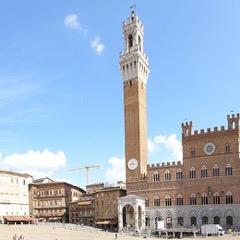 Piazza del CampoThe shell-shaped square at the heart of Siena, paved in red brick and sloping down to the town hall, where the Palio is run.
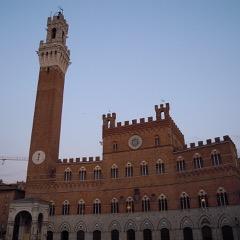 Palazzo PubblicoSiena’s Gothic town hall of brick and stone at the foot of the Campo, with the most famous frescoes of good and bad government.
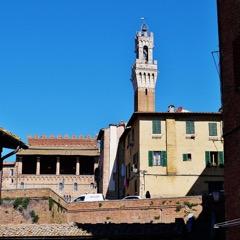 Torre del MangiaThe slender brick tower of the town hall, 88 metres tall, with the stone crown of its bell chamber over the Campo.
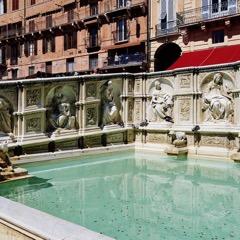 Fonte GaiaThe marble fountain at the top of the Campo, where the water of Siena’s underground aqueducts first reached the square.
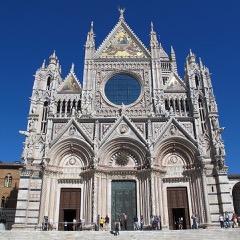 Duomo di SienaThe cathedral on the highest hill of the town, striped in white and dark green marble, with a floor of inlaid marble pictures.
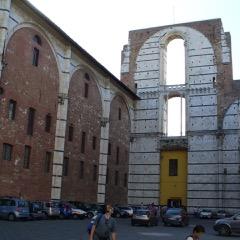 FacciatoneThe bare front of the vast new cathedral that Siena began in 1339 and gave up after the Black Death.
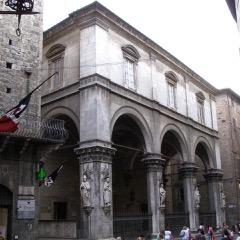 Loggia della MercanziaThe 15th-century loggia of the merchants’ court, at the crossing where Siena’s three main streets meet above the Campo.
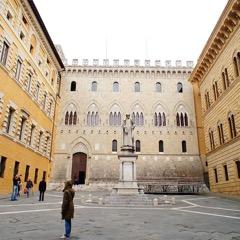 Piazza SalimbeniThe small square of the palaces of the Monte dei Paschi, the oldest bank in the world still in business.
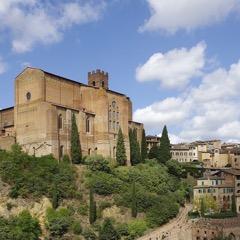 San DomenicoThe great brick church of the Dominicans on its own hill, where Saint Catherine of Siena prayed, and where her head is kept.
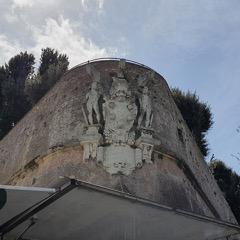 Fortezza MediceaThe fortress that Florence built after it took Siena in 1555, now a park on its walls above the town.
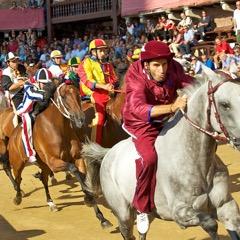 Palio di SienaThe wild horse race round the Campo, run twice every summer between the contrade, the neighbourhoods of the town.
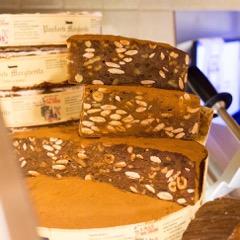 PanforteSiena’s dense cake of honey, almonds, candied fruit and spices, baked here since the Middle Ages.