
Pisa › About the city
This is Pisa
Pisa lies on the Arno in Tuscany, a few kilometres from the sea. In the Middle Ages it was one of Italy’s great sea republics, and its fleet paid for the white marble cathedral, baptistery and bell tower on the Piazza dei Miracoli. The bell tower began to lean while it was being built and has leaned ever since. Today Pisa is above all a university town, with its students on the squares and its palazzi along the river.
Photo: Luca Aless, CC BY-SA 4.0, via Wikimedia Commons

Pisa at a glance
- Country
- Italy
- Region
- Tuscany
- Province
- Pisa, of which it is the capital
- Population
- About 89,000 (city)
- River
- The Arno, which reaches the sea some 10 kilometres downstream
- Language
- Italian
- Patron saint
- Saint Ranieri, feast day 17 June
- World Heritage
- The Piazza del Duomo, on UNESCO’s list since 1987
Known for
- The Leaning Tower, the bell tower that started to lean before it was finished
- The Piazza dei Miracoli, with the Duomo, the Baptistery and the Camposanto in white marble on a green lawn
- Galileo Galilei, who was born here and studied and taught at the university
- The Lungarni along the bend of the Arno, lit with 70,000 candles at the Luminara every June
- The Scuola Normale and the University of Pisa, among the oldest and most selective in Italy
The city
The old town of Pisa lies on both banks of the Arno, which makes a wide bend through the middle of it. North of the river, the medieval town stretches from the Lungarni up to the walls, with Borgo Stretto and its arcades, the market squares and the Piazza dei Cavalieri. In the north-west corner, against the walls, the Duomo, the Baptistery, the bell tower and the Camposanto stand on their lawn. South of the river, in the old quarter of Kinzica, Corso Italia leads from the Logge di Banchi to the station.
Instant Pisa takes you through the heart of it: from the Leaning Tower down Via Santa Maria, the street of the university, to the river, along the Lungarni on both banks, across the Ponte di Mezzo and the Ponte Solferino, past Santa Maria della Spina, and south along Corso Italia to the station. The game draws the tower from OpenStreetMap’s outline and height, so in the game it stands upright.
Where it lies
Pisa lies in the flat plain of the lower Arno, about 10 kilometres from the Tyrrhenian Sea, between Florence, 80 kilometres upstream, and the port of Livorno to the south. In Roman and medieval times the sea came much closer, and the city had its harbour on the coast. The river has brought down so much silt since then that the coast now lies far to the west, beyond the pine woods of San Rossore.
The ground under the city is soft clay and sand, which is why not only the bell tower leans: the Baptistery and many other towers and churches lean too. The climate is Mediterranean, with hot summers and mild, rainy winters, and the Apuan Alps and the Monti Pisani shelter the plain from the north.
Places and landmarks
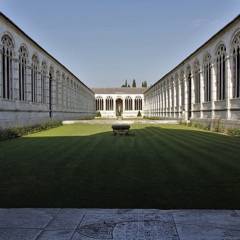 CamposantoThe marble cloister of a cemetery on the north side of the square, said to stand on earth brought back from Golgotha.
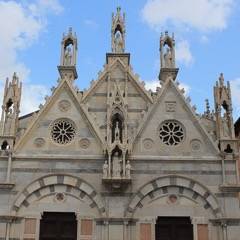 Santa Maria della SpinaA tiny Gothic church on the bank of the Arno, all pinnacles and statues, once home to a thorn from Christ’s crown.
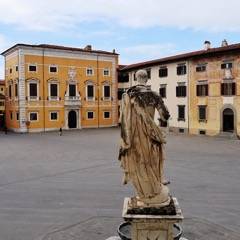 Piazza dei CavalieriThe square of the Knights of Saint Stephen, with Vasari’s painted palace, now the Scuola Normale, and the tower where Count Ugolino starved.
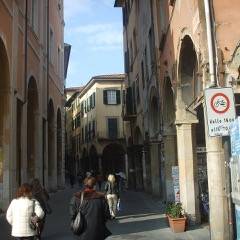 Borgo StrettoPisa’s old shopping street under the arcades, from the Ponte di Mezzo north into the medieval town.
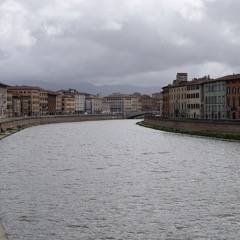 The LungarniThe streets along both banks of the Arno, lined with palazzi in ochre and pink, lit with thousands of candles every 16 June.
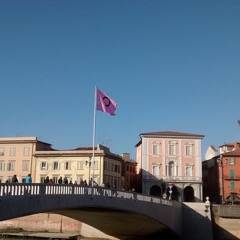 Ponte di MezzoThe middle bridge, where the city has crossed the Arno since Roman times, and where the north and the south of Pisa fight every June.
The centre on a map
The streets, squares and waterways every visitor to Pisa ends up in. Point at one to find it on the map.

-
1
Piazza dei Miracoli Piazza del Duomo square
The cathedral square on its green lawn, with the Duomo, the Baptistery, the tower and the Camposanto.
-
2
Leaning Tower Torre pendente building
The cathedral’s bell tower, leaning about four degrees since the Middle Ages.
-
3
Baptistery Battistero di San Giovanni building
The largest baptistery in Italy, famous for its echo.
-
4
Camposanto building
The marble cloister of the cemetery, its frescoes burnt in 1944.
-
5
Via Santa Maria street
The street of the university, from the Duomo down to the Arno.
-
6
Orto Botanico park
The university’s botanical garden, founded in 1544, one of the oldest in Europe.
-
7
Piazza dei Cavalieri square
The square of the Knights of Saint Stephen and of the Scuola Normale.
-
8
Borgo Stretto street
The old shopping street under the arcades.
-
9
Arno waterway
The river that bends through the middle of the city, on its way from Florence to the sea.
-
10
Lungarno Gambacorti street
The south bank of the Arno, with Santa Maria della Spina and the Palazzo Blu.
-
11
Ponte di Mezzo bridge
The middle bridge, the battlefield of the Gioco del Ponte.
-
12
Santa Maria della Spina building
The tiny Gothic church on the river bank.
-
13
Logge di Banchi building
The open loggia of the silk and wool market, at the south end of the Ponte di Mezzo.
-
14
Corso Italia street
The shopping street of the south bank, closed to cars, from the river to the station.
-
15
Tuttomondo building
Keith Haring’s mural of 1989 on the wall of the convent of Sant’Antonio.
-
16
Pisa Centrale building
The main station, on the line along the coast and to Florence.
History
A sea republic
Pisa was an Etruscan and then a Roman town, with its port on what was then the coast. In the 11th century it grew into one of the four great sea republics of Italy, with Genoa, Venice and Amalfi. Its fleet fought the Saracens, raided Palermo in 1063, sailed with the Crusades and won trading posts all over the Mediterranean, from Sardinia and Corsica to the Levant.
With the spoils the city began its cathedral in 1064, then the Baptistery and the bell tower, and later the Camposanto. Pisan merchants brought new knowledge home too: Leonardo Fibonacci, the son of a Pisan official in North Africa, introduced the Hindu-Arabic numerals to Europe in his Liber Abaci of 1202.
Defeat, and Florence
In 1284 Genoa destroyed the Pisan fleet in the battle of Meloria, and Pisa never recovered its power at sea. Count Ugolino della Gherardesca, accused of treason after the defeat, was starved to death in a tower on the Piazza dei Cavalieri, as Dante tells in the Inferno. The harbour silted up, and in 1406 Florence took the city after a long siege.
Pisa rose against Florence in 1494 and held out for fifteen years before it fell again in 1509. Under the Medici it became a city of learning: Cosimo I refounded the university, set up the Knights of Saint Stephen on the Piazza dei Cavalieri and laid out the botanical garden. Galileo Galilei was born in Pisa in 1564, studied at its university and taught mathematics there.
War and the tower
Pisa became part of the new Kingdom of Italy in 1860. In the Second World War Allied bombs hit the city in 1943, and in the summer of 1944 the front line ran along the Arno for weeks: the retreating Germans blew up the bridges, and a shell set the roof of the Camposanto on fire.
After the war the city rebuilt its bridges and its Lungarni. In 1990 the bell tower leaned so far that it was closed to visitors, and engineers spent eleven years drawing soil out from under its high side until it stood safe again; it reopened in 2001.
Pisa today
Pisa is a university town first: with the University, the Scuola Normale and the Sant’Anna school it has some 50,000 students in a city of under 90,000 people. Millions of visitors come for the Piazza dei Miracoli, many for a day, by train from Florence or through Galileo Galilei airport, the busiest in Tuscany, just south of the centre.
Pisans keep their festivals in June, the Giugno Pisano: the Luminara on the evening of 16 June, when thousands of candles light the Lungarni, the boat race of San Ranieri on the 17th, and the Gioco del Ponte on the last Saturday of the month, when the north and the south of the city fight for the Ponte di Mezzo.
Read on
- Comune di Pisa The city council (in Italian)
- Opera della Primaziale Pisana The Piazza dei Miracoli: tickets for the tower, the cathedral and the museums
- University of Pisa The university, founded in 1343
- Pisa on Wikipedia The encyclopedia article