
Florence › About the city
This is Florence
Florence is the capital of Tuscany, a city of stone palaces and red roofs on the River Arno. In the 15th century, under the Medici, its bankers, architects and artists started the Renaissance, and the works of Brunelleschi, Botticelli, Leonardo and Michelangelo still fill its churches, squares and museums.
Photo: Gary Campbell-Hall, CC BY 2.0, via Wikimedia Commons

Florence at a glance
- Country
- Italy
- Region
- Tuscany
- Population
- About 360,000 (city), almost 1 million (metropolitan city)
- Founded
- 59 BC, as the Roman colony of Florentia, according to tradition
- River
- The Arno
- Language
- Italian
- Nicknames
- The cradle of the Renaissance
- UNESCO World Heritage
- The historic centre, since 1982
Known for
- Brunelleschi’s dome on the cathedral, still the largest brick dome in the world
- Michelangelo’s David and the paintings of the Uffizi
- The Ponte Vecchio, with its goldsmiths’ shops on the bridge
- Bistecca alla fiorentina, Chianti wine and Tuscan leather
The city
Florence lies in a broad valley on the Arno, ringed by hills of olive groves, cypresses and villas. Its historic centre is small enough to cross on foot in half an hour, yet it holds the cathedral with its dome, dozens of churches, palaces and museums, and some of the most famous statues and paintings in the world. The Florentine dialect became the basis of the Italian language, thanks above all to Dante.
The centre, the part you ride through in Instant Florence, lies mostly on the north bank of the river. The Via dei Calzaiuoli runs straight from the cathedral to Piazza della Signoria, with Palazzo Vecchio and the Uffizi beside it; Santa Maria Novella and the station lie to the west, Santa Croce to the east. Across the Ponte Vecchio lies the Oltrarno, the quarter of craftsmen’s workshops, Palazzo Pitti and the Boboli Gardens.
Where it lies
Florence lies in central Italy and is the capital of Tuscany. The Arno comes down from the Apennines, crosses the city from east to west and flows on past Pisa to the Tyrrhenian Sea, about 80 kilometres away. Fiesole, an older Etruscan town, looks down on Florence from its hill to the north, and the wine country of Chianti begins to the south.
Because the city sits in a basin, summers are hot and close, and winters cool and damp. The Arno can rise fast after heavy rain: it has flooded the city many times, worst of all in 1966.
Places and landmarks
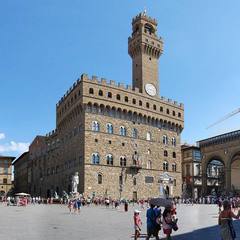 Piazza della SignoriaThe square of the Palazzo Vecchio, with a copy of Michelangelo’s David at its door.
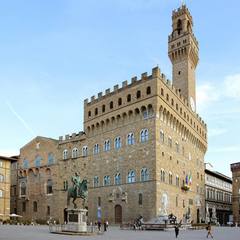 Palazzo VecchioFlorence’s fortress-like town hall since 1299, with its tall tower off to one side.
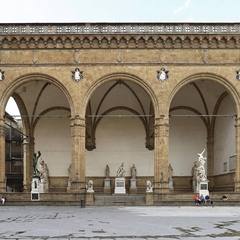 Loggia dei LanziAn open arcade on the square, full of statues, among them Cellini’s Perseus with the head of Medusa.
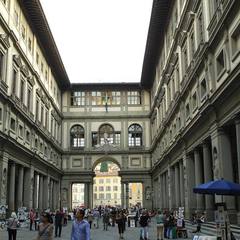 UffiziThe Medici’s offices turned into one of the world’s great museums, with Botticelli’s Birth of Venus.
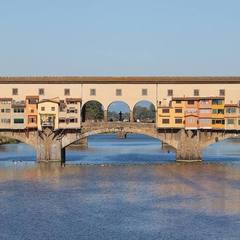 Ponte VecchioThe bridge of goldsmiths over the Arno, the only one the retreating Germans left standing in 1944.
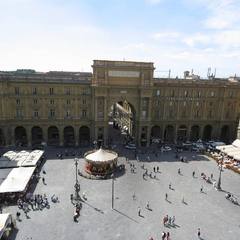 Piazza della RepubblicaWhere the Roman forum was, now a square with a carousel and old cafés under a triumphal arch.
The centre on a map
The streets, squares and waterways every visitor to Florence ends up in. Point at one to find it on the map.

-
1
Piazza del Duomo square
The square around the cathedral, Giotto’s bell tower and the octagonal Baptistery with its gilded bronze doors.
-
2
Via dei Calzaiuoli street
Florence’s main pedestrian street, from the cathedral to Piazza della Signoria past the guild church of Orsanmichele, named after the hosiers who once had their shops here.
-
3
Piazza della Repubblica square
The square that the city cleared from the 1880s on the site of the Roman forum, the old market and the Jewish ghetto, with its triumphal arch and old cafés.
-
4
Piazza della Signoria square
The political heart of Florence for seven centuries, in front of Palazzo Vecchio, with a copy of Michelangelo’s David at its door.
-
5
Piazzale degli Uffizi square
The long, narrow courtyard between the two wings of the Uffizi, which Vasari built from 1560 as offices for the Medici government. Statues of famous Tuscans stand in its niches.
-
6
Ponte Vecchio bridge
The bridge of 1345 lined with shops, where in 1593 Grand Duke Ferdinando I replaced the butchers with goldsmiths.
-
7
The Arno waterway
Florence’s river, between the stone embankments of the lungarni, crossed by the Ponte Vecchio and a string of other bridges.
-
8
Ponte Santa Trinita bridge
Ammannati’s graceful bridge of 1569, blown up in 1944 and rebuilt in 1958 with stones fished out of the river.
-
9
Via de’ Tornabuoni street
Florence’s grandest shopping street, lined with fashion houses and Renaissance palaces such as Palazzo Strozzi.
-
10
Piazza Santa Maria Novella square
The wide square in front of the Dominican church with the black-and-white marble front that Leon Battista Alberti finished.
-
11
Piazza della Santissima Annunziata square
A calm square of arcades, with Brunelleschi’s loggia of the Hospital of the Innocents, the city’s old foundling hospital, along one side.
-
12
Piazza Santa Croce square
The square in front of the Franciscan church where Michelangelo, Galileo and Machiavelli lie buried. In June it becomes the pitch for the calcio storico.
-
13
Piazza Pitti square
The sloping square below Palazzo Pitti, the palace the Medici moved into in the 16th century, with the Boboli Gardens behind it.
-
14
Piazza Santo Spirito square
The village square of the Oltrarno, in front of Brunelleschi’s church with its plain, unfinished front, with a morning market and bars in the evening.
History
Roman colony and medieval commune
The Romans founded Florentia on the north bank of the Arno, according to tradition in 59 BC, as a town for retired soldiers. The grid of their streets still shows in the centre, and Piazza della Repubblica lies on the site of their forum. After the fall of Rome the town shrank, and it only grew again in the 11th and 12th centuries, when it became a self-governing commune.
Florence grew rich on wool and cloth, and on banking. Its guilds ran the city, and its gold coin, the florin, first struck in 1252, was trusted all over Europe. Guelphs and Ghibellines, the parties of the pope and the emperor, fought for power, and in 1302 the winners sent the poet Dante into exile. The Black Death of 1348 killed perhaps half the people of the city.
The Medici and the Renaissance
In the 15th century the Medici family of bankers came to rule the republic from behind the scenes, first Cosimo the Elder and then his grandson Lorenzo the Magnificent. They and other rich families paid for buildings and works of art that broke with the Middle Ages: Brunelleschi raised the dome of the cathedral, Donatello and Masaccio studied the art of the ancients, and Botticelli painted the Birth of Venus.
After Lorenzo’s death the friar Savonarola turned the city against luxury, until he himself was burnt in Piazza della Signoria in 1498. In 1504 Michelangelo’s David was set up in front of Palazzo Vecchio. The Medici came back for good in the 16th century, and Cosimo I became Grand Duke of Tuscany in 1569. His architect Giorgio Vasari built the Uffizi as government offices and the corridor that links them across the Ponte Vecchio to Palazzo Pitti.
From grand duchy to Italy
The last Medici grand duke died in 1737, and Tuscany passed to the House of Lorraine. His sister, Anna Maria Luisa, left the family’s art collections to Florence on condition that they never leave the city. In 1860 Tuscany voted to join the new Kingdom of Italy, and from 1865 to 1871 Florence was its capital. The capital grew fast: the city pulled down its medieval walls and laid out broad avenues, the viali, in their place.
In August 1944 the retreating German army blew up every bridge over the Arno except the Ponte Vecchio. On 4 November 1966 the river flooded the centre, killing dozens of people and damaging thousands of paintings and books; volunteers from all over the world, the mud angels, came to save them. Today the city is one of the most visited in Italy.
Florence today
Florence lives from tourism, from its university and from crafts and fashion: Gucci was founded here in 1921, Ferragamo has its headquarters in a palace on Via de’ Tornabuoni, and twice a year the Pitti Uomo fair brings the men’s fashion trade to the city. Leather workshops and goldsmiths still work in the Oltrarno and around Santa Croce.
The Florentines keep their own traditions. On Easter Sunday a cart of fireworks explodes in front of the cathedral, the Scoppio del Carro, and in June the four old quarters play the calcio storico, a rough game of football in costume, in Piazza Santa Croce. ACF Fiorentina, in violet, plays at the Stadio Artemio Franchi.
Read on
- Feel Florence The official tourist information of Florence
- Comune di Firenze The city council (in Italian)
- Uffizi Galleries Tickets and opening hours for the Uffizi, Palazzo Pitti and the Boboli Gardens
- Historic Centre of Florence on UNESCO The World Heritage listing
- Florence on Wikipedia The encyclopedia article