
Venice › About the city
This is Venice
Venice is a city built on more than a hundred small islands in a lagoon at the top of the Adriatic, where canals take the place of streets and boats the place of cars. For a thousand years it was the capital of a sea-trading republic, and its palaces, churches and squares still stand much as its merchants left them.
Photo: Matthias Süßen, CC BY-SA 4.0, via Wikimedia Commons

Venice at a glance
- Country
- Italy
- Region
- Veneto
- Population
- About 250,000 (municipality, with Mestre on the mainland), fewer than 50,000 in the historic centre
- Founded
- 421, according to tradition
- Water
- The Venetian Lagoon and the Grand Canal
- Language
- Italian, and the Venetian dialect
- Nicknames
- La Serenissima (the Most Serene), the Queen of the Adriatic
- UNESCO World Heritage
- Venice and its Lagoon, since 1987
Known for
- St Mark’s Square, St Mark’s Basilica and the Doge’s Palace
- The Grand Canal, its gondolas and the Rialto Bridge
- The Carnival, with its masks and costumes
- Glass from Murano, lace from Burano and an evening spritz with cicchetti
The city
Venice lies on a cluster of islands in a shallow lagoon, about four kilometres from the mainland. The Venetians drove wooden piles into the mud and built their city on top: brick houses, marble palaces and some 400 bridges over about 150 canals. There are no cars in the historic centre; people walk the narrow lanes, the calli, or take the waterbuses, the vaporetti.
The heart of the city, the part you ride through in Instant Venice, lies around the lower bend of the Grand Canal. Piazza San Marco and the Doge’s Palace open onto the lagoon in the south-east, the Rialto Bridge crosses the canal in the middle, and the Accademia Bridge and the dome of the Salute mark the west. Between them run the Mercerie, the shopping lanes that join San Marco to the Rialto, and dozens of campi, the squares of the old parishes.
Where it lies
Venice lies in the north-east of Italy and is the capital of the region of Veneto. Its lagoon stretches some 50 kilometres along the coast, cut off from the open Adriatic by the long, thin islands of the Lido and Pellestrina. Murano, Burano and Torcello lie in the northern lagoon, and a road and rail bridge links the city to Mestre on the mainland.
The historic centre is divided into six districts, the sestieri: San Marco, Castello, Cannaregio, San Polo, Santa Croce and Dorsoduro. Summers are hot and humid, winters cold and often foggy. In autumn and winter, high tides and the sirocco wind push the sea into the city, the acqua alta, and flood its lowest squares.
Places and landmarks
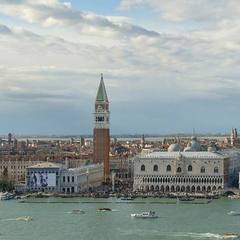 Campanile di San MarcoThe bell tower of St Mark’s, which fell down in 1902 and was rebuilt “where it was, as it was”.
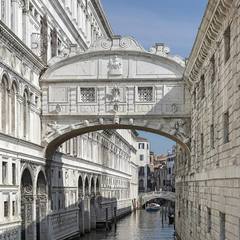 Bridge of SighsThe covered stone bridge between the Doge’s Palace and the prisons, built in 1600.
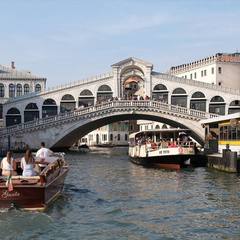 Rialto BridgeThe stone bridge of 1591 over the Grand Canal, with shops along its arch.
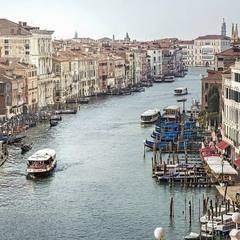 Grand CanalThe great S-shaped waterway through the middle of Venice, lined with palaces.
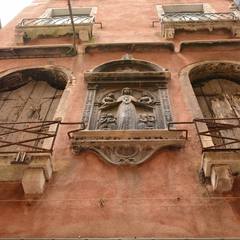 MercerieThe chain of narrow shopping lanes from St Mark’s to the Rialto, the race route in the game.
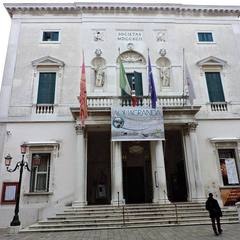 La FeniceVenice’s opera house, which has risen from its ashes more than once, as its name promises.
The centre on a map
The streets, squares and waterways every visitor to Venice ends up in. Point at one to find it on the map.

-
1
St Mark’s Square Piazza San Marco square
Venice’s great square, closed by St Mark’s Basilica at one end and lined on three sides by the arcades of the old government offices.
-
2
Piazzetta San Marco square
The smaller square between the Doge’s Palace and the Marciana Library, which opens onto the lagoon between the columns of St Mark and St Theodore.
-
3
The Mercerie Marzarie street
The chain of shopping lanes from the clock tower on St Mark’s Square to the Rialto, the city’s main street since the Middle Ages.
-
4
Campo San Bartolomeo square
The busy little square at the foot of the Rialto Bridge, where Venetians meet under the bronze statue of the playwright Carlo Goldoni.
-
5
Rialto Bridge Ponte di Rialto bridge
The stone bridge of 1591 over the Grand Canal, with two rows of shops on its arch. Until 1854 it was the only bridge across the canal.
-
6
The Grand Canal Canal Grande waterway
Venice’s main street, an S-shaped waterway of almost four kilometres lined with palaces, which only four bridges cross.
-
7
Campo San Polo square
One of the largest squares in Venice, across the Grand Canal from San Marco, where the city once held bullfights and fairs.
-
8
Campo Santo Stefano square
A long square between the Accademia Bridge and San Marco, with a statue of the writer Niccolò Tommaseo in the middle.
-
9
Accademia Bridge Ponte dell’Accademia bridge
The wooden bridge over the Grand Canal to the Accademia galleries. It went up in 1933 as a temporary bridge and was later rebuilt in the same form.
-
10
Campo della Salute square
The steps of Santa Maria della Salute, the domed church that Baldassare Longhena built at the mouth of the Grand Canal after the plague of 1630.
-
11
Bridge of Sighs Ponte dei Sospiri bridge
The closed white stone bridge that took prisoners from the Doge’s Palace to the prisons across the canal.
-
12
Riva degli Schiavoni street
The broad stone quay along the lagoon east of the Doge’s Palace, named after the merchants from Dalmatia who moored their ships here.
-
13
Campo Santa Maria Formosa square
A wide, irregular square in Castello around the church of Santa Maria Formosa, which Mauro Codussi rebuilt from 1492.
-
14
Campo Santi Giovanni e Paolo square
The square before the great Dominican church where 25 doges lie buried, with Verrocchio’s statue of the mercenary captain Bartolomeo Colleoni on horseback.
-
15
Strada Nova street
The widest street of Cannaregio, which the city cut through houses and filled-in canals in the 19th century to open a walking route towards the railway station.
History
A refuge in the lagoon
Tradition says that Venice was founded on 25 March 421. In fact people from the Roman towns of the mainland fled to the islands of the lagoon over the 5th and 6th centuries, as the Huns, the Goths and then the Lombards swept into Italy. They lived from fishing, salt and trade by boat, nominally under the Byzantine emperors in Constantinople.
The lagoon communities chose their own leader, the doge, and early in the 9th century moved their seat to the islands of the Rialto, which became the city of Venice. In 828 two Venetian merchants smuggled the body of St Mark the Evangelist out of Alexandria, and the city took him and his winged lion as its patron and its emblem.
The Most Serene Republic
Venice grew rich on trade between Europe and the East: spices, silk, salt and slaves. In 1204 Doge Enrico Dandolo steered the Fourth Crusade to Constantinople, which the crusaders sacked; Venice took ports and islands all over the eastern Mediterranean, and the four bronze horses of St Mark’s as loot. Its state shipyard, the Arsenale, built war galleys in series, one after another, and its fleet beat its great rival Genoa at Chioggia in 1380.
The republic was run by a closed circle of noble families, through the Great Council, the Senate and the Council of Ten, with an elected doge at its head. In the 15th and 16th centuries Venice was one of Europe’s largest and richest cities, and painters such as Bellini, Titian, Tintoretto and Veronese worked for its churches, its palaces and its brotherhoods, the scuole. In 1516 the republic made the Jews of the city live in the Ghetto, the first district to be given that name.
Decline and the modern city
The Ottomans took Venice’s eastern possessions one by one, and trade moved to the Atlantic. In 1797 Napoleon’s army arrived, and the last doge, Ludovico Manin, stepped down: the republic ended after more than a thousand years. Napoleon handed the city to Austria, and in 1866 Venice joined the Kingdom of Italy. A railway bridge reached the city from the mainland in 1846, and a road bridge followed in 1933.
On 4 November 1966 the worst flood on record raised the sea almost two metres above its normal level and drew the world’s attention to the danger the sea poses. Since then many Venetians have moved to Mestre, while visitors have come in ever greater numbers. In 2020 the city raised its mobile flood barriers, the MOSE, for the first time.
Venice today
Venice is the capital of the Veneto and a university city, with Ca’ Foscari and the IUAV school of architecture. Tourism drives its economy, and the city now charges day visitors an entry fee on its busiest days. Since 2021 the largest cruise ships may no longer sail past San Marco through the Giudecca Canal. Industry and the port lie on the mainland, at Marghera.
Each year the Biennale fills the Giardini and the Arsenale, with art in odd years and architecture in even ones, and every summer the Venice Film Festival, the oldest film festival in the world, takes over the Lido. On the first Sunday of September the Regata Storica races down the Grand Canal, and on the third Sunday of July the Venetians cross a bridge of boats to the Redentore church on the Giudecca. Venezia FC plays in the Penzo stadium on the island of Sant’Elena.
Read on
- Venezia Unica The city’s official tourist information, tickets and waterbus passes
- Comune di Venezia The city council (in Italian)
- Doge’s Palace Tickets and opening hours for the Doge’s Palace
- Venice and its Lagoon on UNESCO The World Heritage listing
- Venice on Wikipedia The encyclopedia article