
Rotterdam › About the city
This is Rotterdam
Rotterdam lies on the Nieuwe Maas, where the Rhine and the Maas run to the North Sea, in the province of South Holland. On 14 May 1940 German bombers burned out its old centre in one afternoon, and the city rebuilt it as a place to try out new buildings: the Lijnbaan, the cube houses, the Markthal and the Erasmusbrug. Around it lies the biggest port in Europe.
Photo: Michielverbeek, CC BY-SA 4.0, via Wikimedia Commons

Rotterdam at a glance
- Country
- Netherlands
- Province
- South Holland
- Population
- About 670,000 (city)
- River
- The Nieuwe Maas, one of the mouths of the Rhine and the Maas
- Height
- Around sea level, much of it below
- City rights
- 1340
- Language
- Dutch
- Nickname
- Maasstad, the city on the Maas
Known for
- The bombing of 14 May 1940, and the modern city that rose from it
- The Erasmusbrug, the white Swan over the Maas
- Piet Blom’s cube houses and the Markthal’s arch of flats
- The biggest port in Europe, out to the North Sea
- Erasmus, born in Rotterdam, and Feyenoord
The city
Almost nothing of medieval Rotterdam is left. Where the old town stood, between the Coolsingel and the Oude Haven, the centre was rebuilt after the war with broad streets, shopping streets for people on foot and, from the 1980s on, more and more towers. Of the old city only the Laurenskerk, the town hall, the Schielandshuis, the Witte Huis and a few others still stand.
Instant Rotterdam takes you through the heart of it: down the Coolsingel, along the Blaak past the Markthal to the cube houses and the Oude Haven, back up the Binnenrotte and along the Hoogstraat past the Laurenskerk. The Erasmusbrug lies at the southern edge of the map. The city is as flat in real life as it is in the game.
Where it lies
Rotterdam lies in the west of the Netherlands, about 60 kilometres south-west of Amsterdam and 20 kilometres from The Hague, on the Nieuwe Maas. Downstream the river becomes the Nieuwe Waterweg, the canal dug from 1866 to 1872 to give the port its own way to the sea, and the docks run all along it to the Maasvlakte.
Much of the city lies below sea level, behind dikes, on land that was once peat bog. The climate is mild and wet, with sea winds all year round.
Places and landmarks
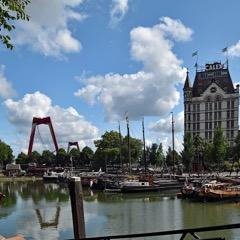 Oude HavenRotterdam’s oldest harbour, full of old sailing barges, with terraces along its quays.
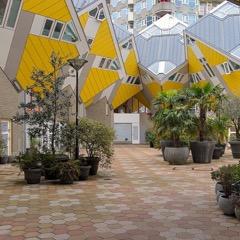 Cube housesPiet Blom’s yellow houses tilted on their corners, a forest of cubes on top of a footbridge over the Blaak.
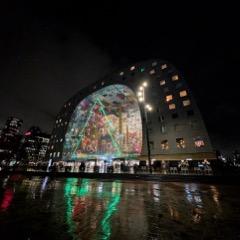 MarkthalA horseshoe arch of flats over a covered market, with the biggest artwork in the Netherlands on its ceiling.
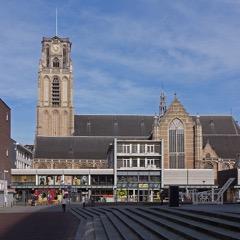 LaurenskerkThe great late-Gothic church of the city, burnt out in 1940 and rebuilt, the last medieval building of the centre.
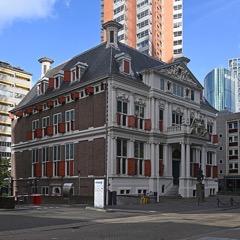 SchielandshuisA 17th-century classical palace among the towers, which came through the bombing of 1940.
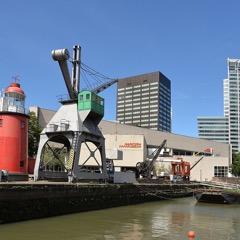 Maritiem MuseumThe maritime museum on the Leuvehaven, with old cranes, a lightship and working boats moored outside.
The centre on a map
The streets, squares and waterways every visitor to Rotterdam ends up in. Point at one to find it on the map.

-
1
Coolsingel street
The broad avenue through the centre, once a canal, with the town hall on it.
-
2
City Hall Stadhuis building
The town hall of 1920, which came through the bombing.
-
3
Lijnbaan street
Europe’s first shopping street built for people on foot.
-
4
Beursplein square
The square by the stock exchange, at the head of the Hoogstraat.
-
5
Laurenskerk Grote of Sint-Laurenskerk building
The last medieval building of the centre, with Erasmus’s statue in front.
-
6
Binnenrotte square
The long square over the old Rotte, where the open-air market is held.
-
7
Markthal building
The market hall under its arch of flats.
-
8
Cube houses Kubuswoningen building
Piet Blom’s tilted yellow houses over the Blaak.
-
9
Blaak street
The broad street along the old harbours, with the station under it.
-
10
Oude Haven waterway
The oldest harbour, full of old barges.
-
11
Witte Huis building
The white office building of 1898.
-
12
Schielandshuis building
The 17th-century water board’s palace among the towers.
-
13
Leuvehaven waterway
The harbour of the Maritiem Museum, with its old ships.
-
14
Plein 1940 square
The square of Zadkine’s De Verwoeste Stad.
-
15
Erasmus Bridge Erasmusbrug bridge
The white Swan over the Maas, to the Kop van Zuid.
History
A dam in the Rotte
Around 1270 people built a dam where the little river Rotte flowed into the Maas, and a fishing village grew up beside it: Rotte-dam. In 1340 the count of Holland gave it city rights. The great humanist Erasmus was born here around 1466.
The town grew with its harbours, dug one after another along the river, and in the 17th century it was the second city of Holland after Amsterdam, trading with the whole world through the Dutch East India Company.
The port of the Rhine
In the 19th century the river silted up and ships could hardly reach the city. The Nieuwe Waterweg, opened in 1872, gave Rotterdam a deep way to the sea, just as the Ruhr in Germany was filling with coal mines and steel works. Rotterdam became the port of the Rhine, and it grew fast, with new docks on the south bank.
Many thousands of emigrants left from here for America on the ships of the Holland America Line, from the quay where Hotel New York now stands.
14 May 1940
Four days after Germany invaded the Netherlands, on 14 May 1940, German bombers attacked the centre of Rotterdam while the two sides were still talking about its surrender. The bombs and the fires that followed destroyed the old town: some 850 people died, about 25,000 homes were lost and 80,000 people were left homeless. The next day the Netherlands surrendered.
The rubble was cleared, and the city chose not to rebuild the old streets. The Basisplan of 1946 laid out a new, open centre, with the Lijnbaan, opened in 1953, as its showpiece.
A city of new buildings
Rotterdam built the first metro of the Netherlands, opened in 1968, the Euromast for the Floriade of 1960, and from 1962 to 2004 it was the busiest port in the world. In the 1980s Piet Blom built his cube houses, and the city began to fill with towers.
The Erasmusbrug opened in 1996, and the Kop van Zuid on the south bank became a second centre. In 2001 Rotterdam was European Capital of Culture, and in 2014 the new Centraal Station and the Markthal opened.
Rotterdam today
Rotterdam is the second city of the Netherlands, a port and a university town where people from some 170 countries live. Its skyline of towers on both banks of the Maas is the only one of its kind in the country, and every year new ones go up.
The city has Feyenoord and its stadium De Kuip, the International Film Festival in January, the North Sea Jazz Festival in July and the Wereldhavendagen, the world port days, in September. The water taxis race up and down the river between the two banks.
Read on
- Rotterdam Info The city’s visitor site
- Maritiem Museum The maritime museum on the Leuvehaven
- Markthal The market hall
- Rotterdam on Wikipedia The encyclopedia article