
Rotterdam › Places and landmarks
Markthal
A horseshoe arch of flats over a covered market, with the biggest artwork in the Netherlands on its ceiling.

MVRDV designed the Markthal, and Queen Máxima opened it in 2014: a market hall of food stalls and restaurants under an arch of 228 flats, with tall glass fronts at both ends.
The inside of the arch is covered in the Hoorn des Overvloeds, the horn of plenty by Arno Coenen and Iris Roskam: giant fruit, vegetables, fish, flowers and insects over some 11,000 square metres. On Tuesdays and Saturdays the open-air market fills the Binnenrotte outside. Visit it in 3D ›
More in Rotterdam
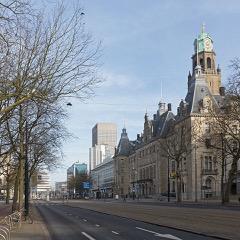 City HallRotterdam’s town hall of 1920 on the Coolsingel, one of the few buildings in the centre that came through the bombing of 1940.
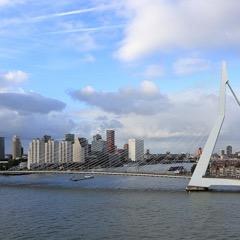 Erasmus BridgeThe white cable-stayed bridge over the Maas, nicknamed the Swan, which became the sign of the new Rotterdam.
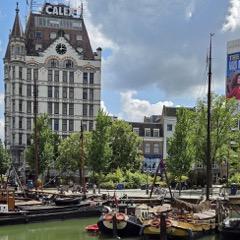 Witte HuisThe white office building of 1898 by the Oude Haven, one of the first high-rise buildings in Europe.
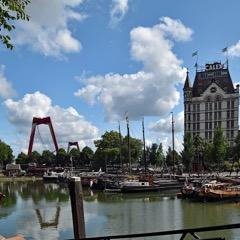 Oude HavenRotterdam’s oldest harbour, full of old sailing barges, with terraces along its quays.
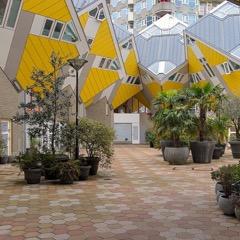 Cube housesPiet Blom’s yellow houses tilted on their corners, a forest of cubes on top of a footbridge over the Blaak.
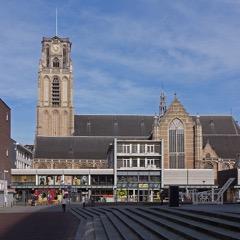 LaurenskerkThe great late-Gothic church of the city, burnt out in 1940 and rebuilt, the last medieval building of the centre.
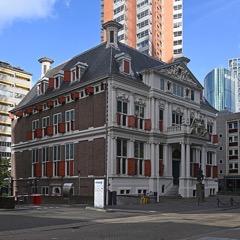 SchielandshuisA 17th-century classical palace among the towers, which came through the bombing of 1940.
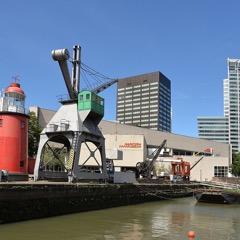 Maritiem MuseumThe maritime museum on the Leuvehaven, with old cranes, a lightship and working boats moored outside.
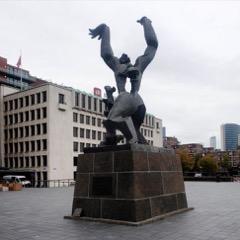 De Verwoeste StadOssip Zadkine’s bronze figure with a hole torn through its body, the memorial to the bombing of 1940.
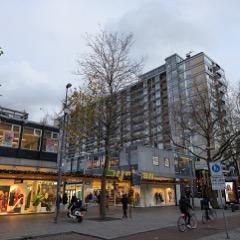 LijnbaanEurope’s first shopping street built for people on foot, opened in 1953 in the rebuilt centre.
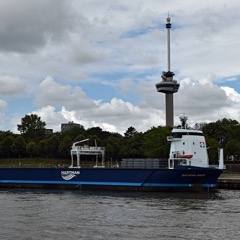 EuromastThe tower in Het Park by the Maas, built for the Floriade of 1960 and raised to 185 metres in 1970.
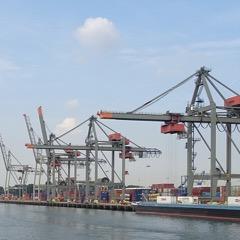 The portThe biggest port in Europe, which runs some 40 kilometres from the city to the North Sea.