
Amsterdam › About the city
This is Amsterdam
Amsterdam is the capital of the Netherlands, a city of canals, narrow brick houses and bicycles. It began as a fishing village at a dam in the river Amstel and, in the 17th century, became the richest trading port in Europe. The canal ring that its merchants dug in that Golden Age still holds the city together today.
Photo: Deerpeter, CC BY-SA 4.0, via Wikimedia Commons

Amsterdam at a glance
- Country
- The Netherlands
- Province
- North Holland
- Population
- About 930,000 (city), about 2.5 million (metropolitan area)
- Founded
- First mentioned in 1275
- Rivers
- The Amstel and the IJ
- Language
- Dutch
- Nicknames
- Mokum, the Venice of the North
- UNESCO World Heritage
- The 17th-century canal ring, since 2010
Known for
- The 17th-century canal ring, with its bridges and tall, narrow merchants’ houses
- Rembrandt, Van Gogh and the Rijksmuseum
- The Anne Frank House on the Prinsengracht
- Bicycles everywhere, canal boats, trams and stroopwafels
The city
Amsterdam lies on the IJ, a former arm of the sea, in a land of reclaimed polders, much of it below sea level. Its houses stand on wooden piles driven through the soft peat into the sand underneath, and its old centre is a horseshoe of canals around the Dam, the square where the city began.
Instant Amsterdam takes you through this centre. From Centraal Station the Damrak leads south to the Dam, with the Royal Palace and the Nieuwe Kerk on its west side. The Rokin and the Kalverstraat continue south to the Spui and the Munt tower, while to the west the Singel, the Herengracht, the Keizersgracht and the Prinsengracht curve around the old town, past the Westerkerk and the Anne Frank House. East of the Dam lie the Oude Kerk, the Red Light District and the Nieuwmarkt.
Where it lies
Amsterdam lies in the province of North Holland, in the west of the Netherlands, about 25 kilometres from the North Sea, to which the North Sea Canal links its port. The IJ separates the old city from Amsterdam-Noord, and the ferries across it from behind Centraal Station are free.
The city has about 165 canals and well over a thousand bridges, more than Venice. Its climate is mild and maritime: cool summers, damp winters, frequent wind and rain at any time of the year.
Places and landmarks
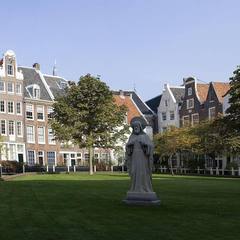 BegijnhofA hidden courtyard of old houses round a garden, behind a door off the Spui.
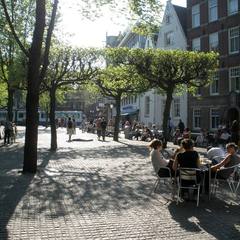 SpuiA small square of bookshops and cafés, with a book market on Fridays.
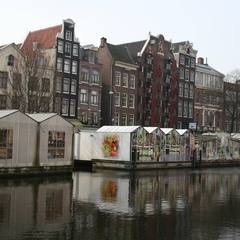 Flower marketThe floating flower market on the Singel, selling bulbs and flowers since 1862.
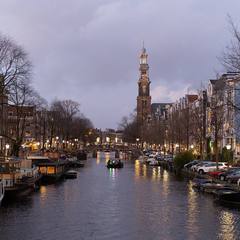 WesterkerkThe church on the Prinsengracht with the tallest tower in Amsterdam, crowned by an imperial crown.
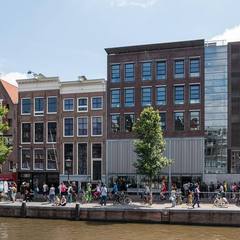 Anne Frank HouseThe canal house where Anne Frank and her family hid from the Nazis and she wrote her diary.
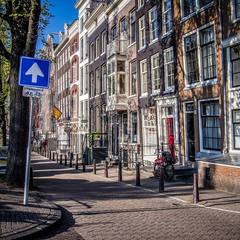 Canal ringThe half-moon of 17th-century canals round the old town, on UNESCO’s World Heritage list.
The centre on a map
The streets, squares and waterways every visitor to Amsterdam ends up in. Point at one to find it on the map.

-
1
Dam Square Dam square
The square on the site of the first dam in the Amstel, with the Royal Palace, the Nieuwe Kerk and the white National Monument to the war dead.
-
2
Damrak street
The busy street from Centraal Station to the Dam, on the old course of the Amstel, with Berlage’s former stock exchange on one side and a row of crooked houses on the water on the other.
-
3
Rokin street
The wide street south of the Dam, where the Amstel flowed until it was filled in, partly in the 1930s; its last stretch of water still holds a few boats.
-
4
Kalverstraat street
Amsterdam’s busiest shopping street, a narrow pedestrian lane from the Dam to the Munt, named after the calf market held here in the Middle Ages.
-
5
Spui square
A square of bookshops and cafés, with a book market on Fridays and the hidden gate to the Begijnhof.
-
6
Muntplein square
The square around the Munttoren, a tower of the medieval city wall where the city minted coins in 1672 and 1673.
-
7
Singel waterway
The innermost canal of the ring, the city’s moat until the 16th century, with the floating flower market at its southern end.
-
8
Herengracht waterway
The first of the three main canals, named after the gentlemen who governed the city, with the grandest houses on its Golden Bend.
-
9
Keizersgracht waterway
The widest of the canals, named after the Holy Roman Emperor Maximilian I.
-
10
Prinsengracht waterway
The outer canal of the three, lined with houseboats, where Anne Frank hid at number 263.
-
11
Westermarkt square
The square below the Westerkerk, the tallest church tower in the city, with the Homomonument by the water.
-
12
Oudezijds Voorburgwal waterway
One of the oldest canals, past the Oude Kerk through the heart of the Red Light District, De Wallen.
-
13
Nieuwmarkt square
A lively square around the Waag, a 15th-century city gate that later became a weigh house, on the edge of Chinatown.
-
14
The Amstel Amstel waterway
The river that gave Amsterdam its name, flowing in from the south past the Stopera and the Skinny Bridge.
History
A dam in the Amstel
In the 13th century the people living at the mouth of the Amstel built a dam across the river to keep out the water of the IJ. A settlement of fishermen and traders grew up around it, and in 1275 Count Floris V of Holland freed them from paying tolls in his county, the oldest written mention of Amsterdam. The town received its city rights around 1300.
In 1345, the story goes, a dying man could not keep down the communion host, which was thrown into the fire and found unburnt. The Miracle of Amsterdam made the town a place of pilgrimage. Its merchants grew rich on beer, herring and the grain trade with the Baltic, and the Oude Kerk, the city’s oldest building, grew with them.
The Golden Age
During the Dutch revolt against Spain, Amsterdam went over to the Protestant side in 1578. When Spanish troops took Antwerp in 1585, thousands of merchants, craftsmen and Jewish families from Spain and Portugal moved north, and Amsterdam took Antwerp’s place as the trading capital of Europe. In 1602 merchants founded the Dutch East India Company, and the shares that people traded in it in Amsterdam made the city home to one of the world’s first stock exchanges.
From 1613 the city council had the canal ring dug, with the Herengracht, the Keizersgracht and the Prinsengracht, and sold the plots along them to wealthy merchants. On the Dam, Jacob van Campen built a new town hall, begun in 1648, the largest in Europe at the time. Rembrandt painted his Night Watch in the city in 1642.
Capital of the Netherlands
Wars with England and France ended the Golden Age, and French troops occupied the country in 1795. In 1808 Louis Napoleon, king of Holland, turned the town hall into his royal palace, and after the French left, the new kingdom named Amsterdam its capital, though the government stayed in The Hague. In the 19th century the North Sea Canal opened a new route to the sea, and the Rijksmuseum and Centraal Station rose on the edges of the old city.
German troops occupied Amsterdam from 1940 to 1945. In February 1941 its workers struck against the persecution of their Jewish neighbours, but the occupiers deported and murdered most of the city’s Jews, among them Anne Frank, who had hidden with her family in a canal house on the Prinsengracht from 1942 to 1944. After the war the city hosted hippies, squatters and protests, and in 2010 UNESCO listed the canal ring as World Heritage.
Amsterdam today
Amsterdam is the capital of the Netherlands, though the king, the government and parliament sit in The Hague. Its economy runs on finance and business services, many of them in the Zuidas district, on technology and creative firms, on the port and on Schiphol, one of Europe’s busiest airports. The Rijksmuseum, the Van Gogh Museum and the Anne Frank House draw visitors from all over the world, and the city council has been trying to limit the crowds in the old centre.
Amsterdammers make many of their trips by bike, on a network of red cycle paths. On King’s Day, 27 April, the canals fill with boats and the whole city turns orange. The football club Ajax plays at the Johan Cruijff ArenA, in the south-east of the city.
Read on
- I amsterdam The city’s official visitor guide
- City of Amsterdam The city council
- Canal Ring of Amsterdam on UNESCO The World Heritage listing
- Amsterdam on Wikipedia The encyclopedia article