
Baptistery
Battistero di San Giovanni
The largest baptistery in Italy, round and domed, where a guard sings a few notes every half hour to let you hear its echo.
Photo: MenkinAlRire, CC BY-SA 4.0, via Wikimedia Commons

Diotisalvi began the baptistery in 1152, in front of the cathedral’s façade. It took two centuries to finish, so its lower floors are Romanesque and its upper ones Gothic, with pinnacles and pointed gables added by Nicola and Giovanni Pisano. It is the largest in Italy, more than 100 metres round, and it leans a little too, towards the cathedral.
Nicola Pisano carved its marble pulpit in 1260, one of the first works of the new sculpture that looked back to ancient Rome. Under the dome the sound carries so well that a guard sings a few notes every half hour, and the echo turns them into a chord. Visit it in 3D ›
More in Pisa
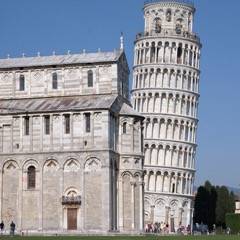 Leaning Tower of PisaThe cathedral’s bell tower, which started to lean before its third floor was finished and has leaned ever since, some four degrees today.
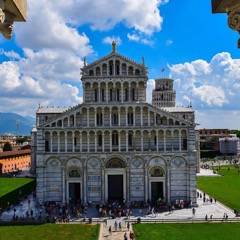 Duomo di PisaThe marble cathedral of 1064, paid for with the spoils of a raid on Palermo, the first great building of the Pisan Romanesque.
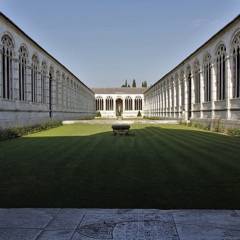 CamposantoThe marble cloister of a cemetery on the north side of the square, said to stand on earth brought back from Golgotha.
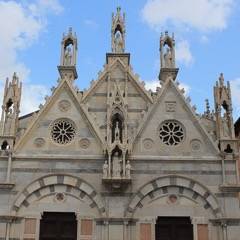 Santa Maria della SpinaA tiny Gothic church on the bank of the Arno, all pinnacles and statues, once home to a thorn from Christ’s crown.
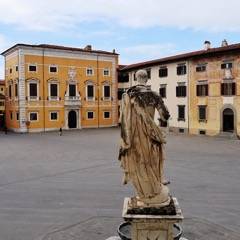 Piazza dei CavalieriThe square of the Knights of Saint Stephen, with Vasari’s painted palace, now the Scuola Normale, and the tower where Count Ugolino starved.
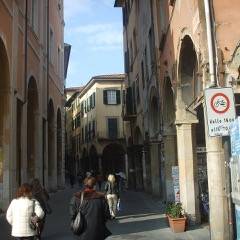 Borgo StrettoPisa’s old shopping street under the arcades, from the Ponte di Mezzo north into the medieval town.
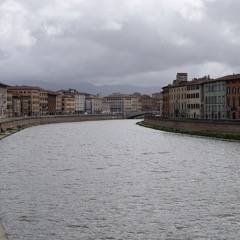 The LungarniThe streets along both banks of the Arno, lined with palazzi in ochre and pink, lit with thousands of candles every 16 June.
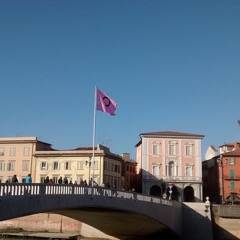 Ponte di MezzoThe middle bridge, where the city has crossed the Arno since Roman times, and where the north and the south of Pisa fight every June.
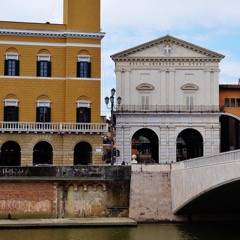 Logge di BanchiThe open loggia at the south end of the Ponte di Mezzo, built around 1605 for the silk and wool traders.
TuttomondoKeith Haring’s last big mural, painted in 1989 on the back wall of the convent of Sant’Antonio, near the station.
Gioco del PonteOn the last Saturday of June the north and the south of Pisa push a cart across the Ponte di Mezzo, after a parade in Renaissance costume.
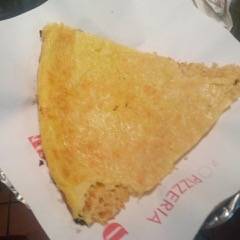 CecinaA thin, golden flatbread of chickpea flour, water and olive oil, baked in a copper pan in a wood oven and eaten hot with pepper.