Baroque Lecce
Ride past Santa Croce and into the Piazza del Duomo, look down into the Roman amphitheatre under Piazza Sant'Oronzo, and find Charles V's castle and the three city gates.
 Instant Cities: Lecce
Explore or race by bike, on foot or on horseback through baroque Lecce!
Ride through the old town of Lecce in Puglia, in its honey-coloured pietra leccese, with shutters and flat roof terraces.
Free · no account · works on PC, tablet and phone
Ride past Santa Croce and into the Piazza del Duomo, look down into the Roman amphitheatre under Piazza Sant'Oronzo, and find Charles V's castle and the three city gates.
Race Lecce Centre, a loop past the Duomo, Porta Rudiae, Porta Napoli and Santa Croce, or sprint from the station to Sant'Oronzo.
Beat short missions against the clock: catch the thief who ran off with the papier-mâché statue of Sant'Oronzo.
Lecce is the main city of the Salento, the heel of Italy, a few kilometres from the Adriatic. In the 16th and 17th centuries its builders carved the soft, golden local stone into churches and palaces so richly decorated that the style took the city’s name: Lecce Baroque.
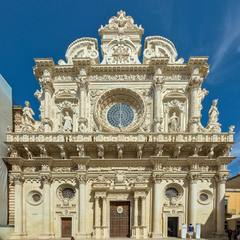 Basilica di Santa CroceThe high point of Lecce Baroque, built between 1549 and 1695. Its façade is smothered in lions, plants, mythical beasts and saints, all carved in the soft, honey-coloured local limestone. Next door stands the Palazzo dei Celestini, now the provincial government’s seat.
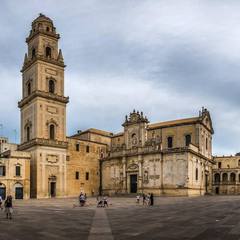 Piazza del DuomoAn enclosed square that only reveals itself once you step inside. The cathedral was rebuilt in 1659 by Giuseppe Zimbalo, and its campanile is 70 m tall. The Bishop’s Palace and the Seminary stand around the square too, all in the same Baroque stone.
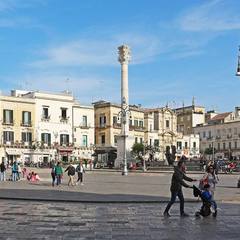 Piazza Sant’OronzoThe heart of Lecce. The 2nd-century Roman amphitheatre lies half sunk beneath the square and once held around 25,000 spectators. On a column that came from Brindisi stands Saint Oronzo, the city’s patron. Close by is the Sedile, the old town hall from 1592.
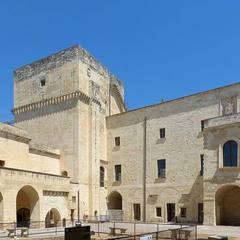 Charles V CastleA castle with a square plan and broad bastions, rebuilt in the 1530s on the orders of Emperor Charles V to defend the city against the Turks. It has also been a prison and a barracks. Today it hosts exhibitions, and the papier-mâché museum.
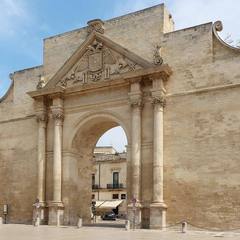 Porta NapoliA triumphal arch from 1548, built for Charles V, and the grandest of the city’s three gates. It faces the road to Naples, hence the name. On the square in front stands an obelisk from 1822, in honour of King Ferdinand I.
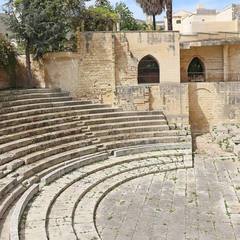 Roman TheatreA small Roman theatre from the time of Emperor Augustus, only rediscovered in the 1930s among the houses. It held about 5,000 spectators. You can still see its semicircular tiers and floor mosaics.
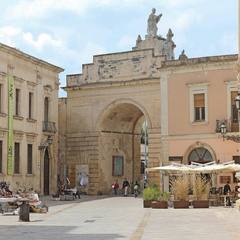 Porta RudiaeThe city’s western gate, rebuilt in 1703 in Baroque style. It is named after Rudiae, the ancient town of the poet Ennius just outside Lecce. Above the gateway sits Saint Oronzo, flanked by Saint Domenico and Saint Irene.
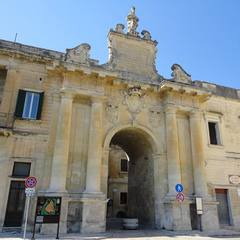 Porta San BiagioThe southern city gate, built in 1774 and dedicated to Saint Blaise. It leads into the old town from the road to Otranto and the Adriatic coast, and is the last of the three gates still standing.
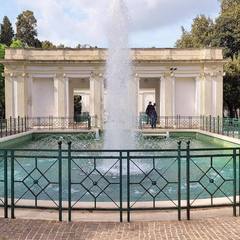 Villa ComunaleThe Giuseppe Garibaldi city park, just outside the old walls. A calm spot among palms and trees, close to the castle and the centre. A good place to hide from the southern sun for a while.
Still in development: expect some rough edges.