
Vienna › About the city
This is Vienna
Vienna is the capital of Austria and, for more than six hundred years, was the seat of the Habsburgs, who ruled a great part of Europe from its palaces. Mozart, Beethoven and Strauss made music here, Freud and Klimt changed how people saw the mind and art, and the city still keeps its imperial palaces, its Ringstraße and its old coffee houses.
Photo: Dietmar Rabich, CC BY-SA 4.0, via Wikimedia Commons

Vienna at a glance
- Country
- Austria
- Region
- Vienna is a federal state of its own
- Population
- About 2 million (city), 2.9 million (metropolitan area)
- Founded
- As the Roman fort of Vindobona, around AD 100
- River
- The Danube, with the Danube Canal along the old town
- Language
- German
- Nicknames
- The City of Music
- UNESCO World Heritage
- The historic centre, since 2001, and Schönbrunn Palace, since 1996
Known for
- St Stephen’s Cathedral and its tall Gothic spire in the middle of the old town
- The Hofburg and Schönbrunn, the winter and summer palaces of the Habsburg emperors
- Classical music, from the State Opera and the waltz to the Philharmonic’s New Year’s Concert
- Coffee houses, Sachertorte and Wiener Schnitzel
The city
Vienna lies on the Danube, at the foot of the last hills of the Alps, the Vienna Woods. The old town, the Innere Stadt, is small: a ring of streets around St Stephen’s Cathedral that the city walls held in until the 1850s. When Emperor Franz Joseph had the walls torn down, the city built the Ringstraße in their place, a wide boulevard lined with the Opera, the Parliament, the City Hall and the great museums.
The centre you ride through in Instant Vienna is this old town. From Stephansplatz the Graben and the Kohlmarkt lead west to the Hofburg, the emperors’ palace, with the Heldenplatz and the Ring beyond it. Kärntner Straße runs south to the State Opera, and to the north, quiet squares like Am Hof, the Judenplatz and the Hoher Markt lie on the ground of the Roman fort, above the Danube Canal.
Where it lies
Vienna lies in the east of Austria, close to the borders with Slovakia, the Czech Republic and Hungary; Bratislava is only about 55 kilometres away. The Danube flows past the city to the north-east, and the narrower Danube Canal runs along the edge of the old town.
To the west and north the Vienna Woods rise in green hills, and vineyards grow inside the city limits, which makes Vienna one of the few capitals that produce their own wine. The climate is continental, with hot summers and cold winters.
Places and landmarks
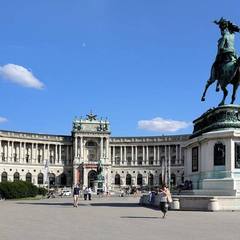 HofburgThe Habsburgs’ winter palace for six centuries, now the seat of Austria’s president.
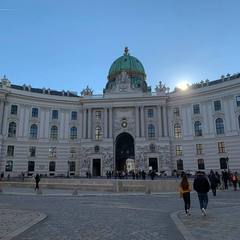 MichaelerplatzThe round square at the Hofburg’s gate, where Roman ruins and Adolf Loos’ plain house face the palace.
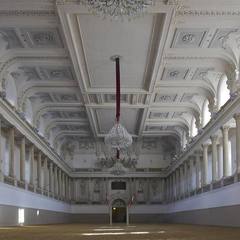 Spanish Riding SchoolThe white Lipizzaner stallions dance in a Baroque riding hall inside the Hofburg.
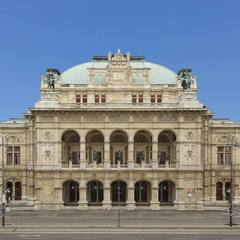 State OperaOpened in 1869, the first great building on the Ringstraße and one of the world’s great opera houses.
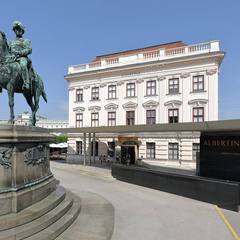 AlbertinaA Habsburg palace with one of the world’s largest collections of prints and drawings, Dürer’s Hare among them.
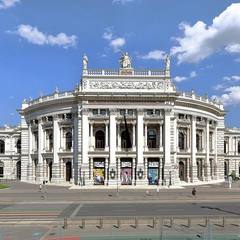 BurgtheaterOne of the most important German-language theatres, on the Ringstraße, opposite the town hall.
The centre on a map
The streets, squares and waterways every visitor to Vienna ends up in. Point at one to find it on the map.

-
1
Stephansplatz square
The square around St Stephen’s Cathedral, where the Graben, Kärntner Straße and Rotenturmstraße meet. Under it lies the Virgilkapelle, a medieval chapel that builders found in 1973 while digging the metro.
-
2
Graben street
A wide pedestrian street on the line of the ditch of the Roman fort, which gave it its name. The Baroque Plague Column stands in the middle.
-
3
Kärntner Straße street
The busy shopping street from St Stephen’s to the State Opera, named after Carinthia, Kärnten, the province the old road led to.
-
4
Neuer Markt square
A square off Kärntner Straße with the Donner Fountain and the Capuchin Church, whose crypt holds the tombs of the Habsburgs.
-
5
Albertinaplatz square
The square below the Albertina, behind the State Opera, with Alfred Hrdlicka’s memorial against war and fascism.
-
6
Kohlmarkt street
The short, elegant street from the Graben to the Hofburg, named after the charcoal once sold there, with jewellers, fashion houses and the confectioner Demel.
-
7
Michaelerplatz square
The round square in front of the Hofburg’s domed Michael Gate, with Roman remains in its middle and the plain Looshaus, which shocked the Viennese in 1911.
-
8
Josefsplatz square
A courtyard-like square of the Hofburg with an equestrian statue of Joseph II, in front of the Baroque State Hall of the National Library.
-
9
Heroes’ Square Heldenplatz square
The great open square of the Hofburg, with statues of Prince Eugene and Archduke Charles on horseback. From the balcony of the New Castle Hitler proclaimed the annexation of Austria here in 1938.
-
10
The Ringstraße Ringstraße street
The boulevard around the old town that took the place of the city walls from 1857, lined with the Opera, the Parliament, the City Hall and the great museums.
-
11
Herrengasse street
The street of the nobles’ town palaces, from the Michaelerplatz to the Freyung, with the old parliament of Lower Austria and the Café Central.
-
12
Am Hof square
The largest square of the old town, where the Babenberg dukes kept their court. From the balcony of its church a herald proclaimed the end of the Holy Roman Empire in 1806.
-
13
Judenplatz square
The centre of the medieval Jewish quarter, destroyed in 1421, with Rachel Whiteread’s Holocaust memorial, a library cast in concrete with its books turned inside out.
-
14
Hoher Markt square
One of Vienna’s oldest squares, above the remains of the Roman fort, with the Ankeruhr, an Art Nouveau clock across which historical figures parade at noon.
-
15
The Danube Canal Donaukanal waterway
The arm of the Danube along the north-east edge of the old town; the main river flows further out. In summer bars and deckchairs fill its banks.
History
From Roman fort to Habsburg seat
The Romans built the legionary fort of Vindobona on the Danube around AD 100, on the frontier of their empire; the Graben follows the line of its ditch. After the Romans left, a small town survived inside the old walls. In the 12th century the Babenberg dukes made Vienna their residence and held court on the square Am Hof, and the first St Stephen’s Church rose just outside the old walls.
In 1278 Rudolf of Habsburg defeated King Ottokar of Bohemia, and his family went on to rule from Vienna until 1918. Duke Rudolf IV founded the university in 1365 and enlarged St Stephen’s in Gothic style; its south tower, finished in 1433, still rises above the old town.
The imperial capital
As the Habsburgs gathered crowns across central Europe, Vienna became the capital of a great empire and the bulwark against the Ottomans, who besieged it in 1529 and 1683. After the second siege failed, nobles and emperors built Baroque palaces such as the Belvedere and Schönbrunn, and the Karlskirche. Maria Theresa reformed the state from the Hofburg, and Haydn, Mozart and Beethoven worked in the city. In 1814 and 1815 the Congress of Vienna redrew the map of Europe after Napoleon.
Franz Joseph ruled for 68 years, from 1848 to 1916. He had the walls torn down from 1857 and gave Vienna the Ringstraße. Around 1900 the city passed two million inhabitants and lived its most creative years: Sigmund Freud founded psychoanalysis, Gustav Klimt and the Secession broke with academic art, and Gustav Mahler led the Court Opera.
Capital of the republic
The empire fell apart at the end of the First World War, and in 1918 Vienna became the oversized capital of a small Austrian republic. Its Social Democrat council built large blocks of council flats for workers, the era of Red Vienna. In March 1938 Nazi Germany annexed Austria, and the Nazis drove out and murdered most of the city’s large Jewish community. Allied bombs and the battle for Vienna in 1945 damaged St Stephen’s and the Opera.
The four Allied powers occupied the city together for ten years, the Vienna of the film The Third Man. The State Treaty of 1955 made Austria independent and neutral, and Vienna became a meeting place between East and West, with offices of the United Nations, the OSCE and OPEC. Austria joined the European Union in 1995.
Vienna today
Vienna is Austria’s capital and largest city, one of its nine federal states, and the seat of the government and parliament. It hosts one of the four main offices of the United Nations, the International Atomic Energy Agency, OPEC and the OSCE. Its economy runs on services, research, tourism and congresses, and the city regularly tops international rankings of the most liveable cities.
The city owns or funds a large share of its housing, so many Viennese rent council flats. Life moves between the coffee house, the wine taverns, the Heurigen, on the edge of town, and the concert halls. In winter the ball season fills the palaces, and on 1 January the Vienna Philharmonic plays its New Year’s Concert to a worldwide television audience.
Read on
- Vienna Tourist Board The city’s official tourist information
- City of Vienna The city council
- Kunsthistorisches Museum The great art museum on the Ringstraße
- Historic Centre of Vienna on UNESCO The World Heritage listing
- Vienna on Wikipedia The encyclopedia article