
San Francisco › About the city
This is San Francisco
San Francisco lies on the tip of a peninsula in northern California, between the Pacific Ocean and San Francisco Bay, a city of steep hills, painted wooden houses and summer fog. It grew from a small Spanish mission into a boom town in the Gold Rush, burnt down in 1906 and was rebuilt at once. Today it is known for its cable cars, the Golden Gate Bridge, Chinatown and the tech companies of the Bay Area.
Photo: Dllu, CC BY-SA 4.0, via Wikimedia Commons

San Francisco at a glance
- Country
- United States
- State
- California
- Population
- About 830,000 (city), 7.7 million in the Bay Area
- Lies
- On the tip of a peninsula between the Pacific and San Francisco Bay
- Height
- From sea level to 282 m on Mount Davidson, on more than forty hills
- Language
- English, with Chinese and Spanish widely spoken
- Known for
- The Golden Gate Bridge, cable cars, fog and hills
- Founded
- 1776, as a Spanish fort and mission
Known for
- The Golden Gate Bridge in the fog
- The cable cars climbing the hills
- Chinatown, the oldest in North America
- Alcatraz, the prison island in the bay
- The earthquake and fire of 1906
- The Beat poets of North Beach
The city
The centre of San Francisco lies in its north-east corner, by the bay. Market Street runs from the Ferry Building on the waterfront south-west through the city, and north of it lie the towers of the Financial District, Union Square with its shops and hotels, Chinatown along Grant Avenue, and North Beach, the old Italian quarter round Washington Square. Above it all rises Telegraph Hill with Coit Tower on top, and along the bay runs the Embarcadero, past the piers.
Instant San Francisco takes you through the heart of it: down Grant Avenue through Chinatown to the Dragon Gate, along Bush Street through the Financial District, down Market Street to the Ferry Building, along the Embarcadero by the bay and back along Washington Street, past the Transamerica Pyramid and Portsmouth Square. Unlike the real city, the game is flat.
Where it lies
San Francisco covers the northern tip of the San Francisco Peninsula, about eleven kilometres across. The Pacific lies to the west, the Golden Gate strait to the north, and the bay to the east, with Oakland and Berkeley on its far shore. The streets run in a straight grid over more than forty hills, so many of them climb at slopes no car would take elsewhere. The San Andreas Fault runs just off the coast to the west.
The climate is mild all year. Winters are cool and bring most of the rain, and summers are cool too: on many afternoons the fog rolls in from the ocean through the Golden Gate and covers the bridge and the western half of the city, while the sun still shines on the bay side. Snow almost never falls.
Places and landmarks
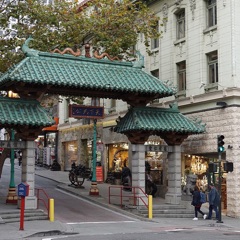 Dragon GateThe gate into Chinatown on Grant Avenue at Bush Street, with green tiled roofs, dragons and two stone lions.
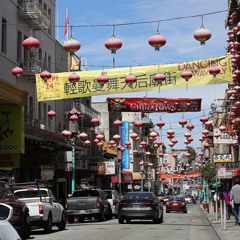 ChinatownThe oldest Chinatown in North America, along Grant Avenue and Stockton Street, with lanterns over the street.
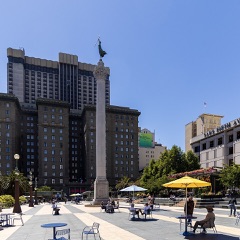 Union SquareThe square of the big shops and hotels, named after the rallies for the Union before the Civil War.
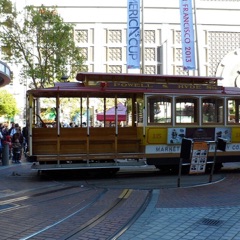 Cable carsThe last cable cars in the world still running in city streets, pulled up the hills by a cable under the road.
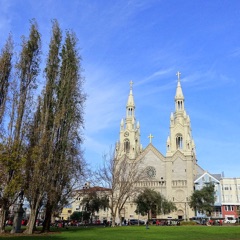 Washington SquareThe green heart of North Beach, the Italian quarter, before the white church of Saints Peter and Paul.
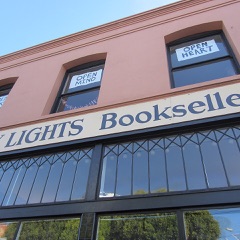 City LightsThe bookshop of the Beat poets on Columbus Avenue, which published Allen Ginsberg’s Howl in 1956.
The centre on a map
The streets, squares and waterways every visitor to San Francisco ends up in. Point at one to find it on the map.

-
1
Union Square square
The square of the department stores and hotels, with the Dewey Monument in the middle.
-
2
Powell Street street
The street of the cable cars, from their turntable at Market Street up Nob Hill.
-
3
Dragon Gate gate
The green-roofed gate into Chinatown at Grant Avenue and Bush Street.
-
4
Grant Avenue street
The main street of Chinatown, under strings of red lanterns.
-
5
Portsmouth Square square
The old plaza of Yerba Buena, where the city began, now Chinatown’s living room.
-
6
California Street street
The cable car line from the Financial District up Nob Hill, past Old St. Mary’s.
-
7
Transamerica Pyramid building
The white pyramid of 1972, 260 metres tall.
-
8
Jackson Square quarter
A few blocks of brick buildings from the Gold Rush that survived the fire of 1906.
-
9
Market Street street
The city’s main avenue, from the Ferry Building south-west across the city.
-
10
Ferry Building building
The ferry terminal of 1898 with its clock tower, now a food hall.
-
11
The Embarcadero street
The boulevard along the bay and its piers, with palm trees and old streetcars.
-
12
Columbus Avenue street
The diagonal street of North Beach, from the Transamerica Pyramid to the bay.
-
13
City Lights building
The bookshop of the Beat poets, at Columbus Avenue and Broadway.
-
14
Washington Square park
The park of North Beach, before the church of Saints Peter and Paul.
-
15
Telegraph Hill quarter
The steep hill over the bay, with wooden houses along the Filbert Steps and wild parrots.
-
16
Coit Tower building
The concrete tower on top of Telegraph Hill, with murals inside.
History
A mission and a cove
The Ohlone people lived round the bay for thousands of years before the Spanish arrived. In 1776 Spain founded a fort, the Presidio, and the Mission San Francisco de Asís, named after Saint Francis of Assisi, on the peninsula.
In 1835 a small trading village, Yerba Buena, grew up by a cove on the bay, round a plaza that is now Portsmouth Square. In 1846, in the war with Mexico, the crew of the USS Portsmouth raised the American flag on that plaza, and a year later the village took the name of San Francisco.
The Gold Rush
In 1848 gold was found in the foothills of the Sierra Nevada, and San Francisco was the port everyone came through. In two years the village of about a thousand people grew into a city of tens of thousands, of tents, shacks and gambling halls. Crews left their ships in the cove to go digging, and some of the ships were used as stores and lodgings.
The cove was filled in to make more land, ships and all, and the shore moved out several blocks. Montgomery Street, where the Transamerica Pyramid now stands, was once on the water. Chinese migrants came too, and settled round the old plaza: the start of Chinatown.
The earthquake and fire
At 5:12 in the morning of 18 April 1906 a great earthquake shook the city. Gas pipes broke and fires started everywhere, and with the water mains broken too they burnt for three days. About 28,000 buildings were lost, most of the city east of Van Ness Avenue, and some three thousand people died.
The city was rebuilt fast, on the same street plan. Chinatown came back with pagoda roofs, and in 1915 San Francisco held a world’s fair, the Panama-Pacific International Exposition, to show it had risen again.
Bridges, Beats and tech
The Bay Bridge to Oakland opened in 1936 and the Golden Gate Bridge in 1937, and the ferries lost most of their passengers. In the 1950s the Beat poets gathered in North Beach round the City Lights bookshop, and in 1967 young people from all over the country came to the Haight-Ashbury for the Summer of Love.
On 17 October 1989 the Loma Prieta earthquake damaged the double-decker freeway along the Embarcadero, and the city pulled it down, opening the waterfront again. Since the 1990s the tech companies of Silicon Valley have spread into the city, and new towers such as the Salesforce Tower have risen south of Market Street.
San Francisco today
San Francisco has about 830,000 people, and is the cultural centre of a Bay Area of nearly eight million. Many of the world’s tech companies have their offices here or just to the south, and the city is known for its restaurants, its parks and its long history as a place where people come to live differently.
Visitors ride the cable cars, walk across the Golden Gate Bridge, take the ferry to Alcatraz and eat at the Ferry Building and Fisherman’s Wharf. Housing is among the most expensive in the country, and the city still argues over how it should grow.
Read on
- San Francisco Travel The city’s tourist site
- SFMTA: Cable cars Lines, fares and history of the cable cars
- Ferry Building Marketplace The food hall and farmers’ market
- City Lights Booksellers The bookshop of the Beats
- San Francisco on Wikipedia The encyclopedia article