
Prague › About the city
This is Prague
Prague is the capital of the Czech Republic and the largest city of Bohemia, built on both banks of the Vltava. Its old centre came through the wars of the 20th century almost untouched, so Gothic towers, Baroque churches and Art Nouveau façades still line the same streets, under a castle that kings, emperors and presidents have ruled from for over a thousand years.
Photo: Diliff, CC BY-SA 3.0, via Wikimedia Commons

Prague at a glance
- Country
- Czech Republic (Czechia)
- Region
- Prague is a region of its own, the capital city of Prague
- Population
- About 1.4 million (city)
- Founded
- The castle in the late 9th century; the legend credits Princess Libuše
- River
- The Vltava
- Language
- Czech
- Nicknames
- The City of a Hundred Spires, Golden Prague
- UNESCO World Heritage
- The historic centre, since 1992
Known for
- Charles Bridge and its statues, with Prague Castle on the hill behind it
- Old Town Square, the Týn Church and the astronomical clock that has struck the hours since 1410
- The Jewish Town, with its synagogues and old cemetery, and the city of Franz Kafka
- Czech beer, pilsner poured with a thick head, and the red trams on the cobbles
The city
Prague lies in a bend of the Vltava, with hills on either side of the river. For centuries it was not one town but four: the Old Town and the New Town on the right bank, and the Lesser Town and the castle district of Hradčany on the left. Emperor Joseph II joined them into a single city in 1784, and Prague still keeps their names and their squares.
The centre you ride through in Instant Prague is the right bank. Old Town Square sits in the middle of a tangle of lanes, with the Jewish Town of Josefov to the north and the Royal Way running from the Powder Tower along Celetná and Karlova to Charles Bridge. South and east of the Old Town, Na Příkopě and Národní třída follow the line of the old moat, and Wenceslas Square climbs up through the New Town to the National Museum.
Where it lies
Prague lies in the middle of Bohemia, the western half of the Czech Republic, roughly halfway between Berlin and Vienna. The Vltava, the longest river in the country, flows north through the city and joins the Elbe some 30 kilometres downstream.
The city spreads over a hilly landscape: Prague Castle stands on a ridge above the left bank, and the green slopes of Petřín rise beside it. The climate is mild continental, with warm summers and cold, often grey winters.
Places and landmarks
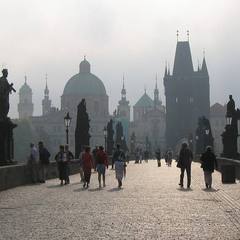 Charles BridgeThe stone bridge of 1357 across the Vltava, lined with thirty statues of saints.
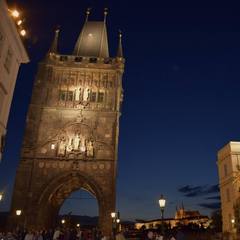 Old Town Bridge TowerThe Gothic gate tower at the Old Town end of the Charles Bridge, one of the finest in Europe.
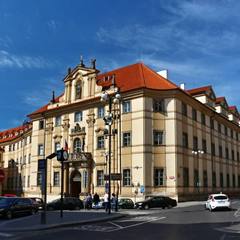 KlementinumThe vast Jesuit college beside the bridge, with a Baroque library hall and an astronomical tower.
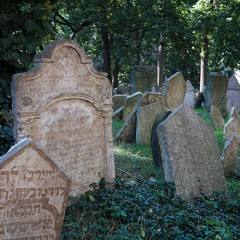 JosefovPrague’s Jewish Quarter, with old synagogues and the Old Jewish Cemetery.
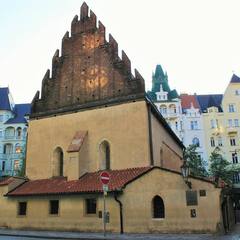 Old-New SynagogueBuilt around 1270, the oldest synagogue in Europe still in use.
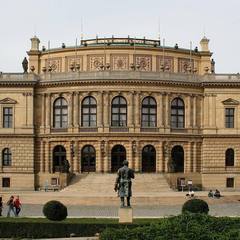 RudolfinumThe neo-Renaissance concert hall on the Vltava, home of the Czech Philharmonic.
The centre on a map
The streets, squares and waterways every visitor to Prague ends up in. Point at one to find it on the map.

-
1
Old Town Square Staroměstské náměstí square
The heart of the Old Town since the Middle Ages, between the Týn Church and the Old Town Hall with its astronomical clock. The memorial to Jan Hus stands in the middle.
-
2
Celetná street
The first stretch of the Royal Way, the coronation route of the Bohemian kings, from the Powder Tower to Old Town Square.
-
3
Fruit Market Ovocný trh square
The old fruit market in front of the Estates Theatre, where Mozart’s Don Giovanni had its première in 1787. The Carolinum, the oldest building of Charles University, stands beside it.
-
4
Na Příkopě street
A shopping street on the line of the moat that once divided the Old Town from the New Town. Its name means ‘on the moat’.
-
5
Wenceslas Square Václavské náměstí square
The long horse market of Charles IV’s New Town, climbing to the statue of St Wenceslas and the National Museum. Praguers gathered here in 1918, 1968 and 1989.
-
6
Národní třída street
The avenue from the National Theatre on the Vltava to the edge of the Old Town. On 17 November 1989 riot police beat a student march here, and the Velvet Revolution began.
-
7
Karlova street
A crooked lane of the Royal Way that winds from the Old Town to Charles Bridge, past the walls of the Klementinum.
-
8
Knights of the Cross Square Křižovnické náměstí square
The small square at the Old Town end of Charles Bridge, between the Old Town Bridge Tower, the Klementinum and the church of the Knights of the Cross.
-
9
Charles Bridge Karlův most bridge
The stone bridge over the Vltava that Charles IV began in 1357, lined with thirty statues of saints. Until 1841 it was Prague’s only bridge across the river.
-
10
The Vltava Vltava waterway
The longest river in the Czech Republic, between the Old Town and the Lesser Town. Smetana set it to music in his symphonic poem Vltava.
-
11
Kampa quarter
The island on the Lesser Town side of the river, cut off by a narrow millstream, the Čertovka or Devil’s Stream, with a park and old mill wheels.
-
12
Jan Palach Square náměstí Jana Palacha square
The riverside square in front of the Rudolfinum concert hall, named after the student who set himself on fire in 1969 in protest against the Soviet occupation.
-
13
Pařížská street
The broad avenue that the city cut through the Jewish Town around 1900, from Old Town Square to the Vltava, lined with Art Nouveau houses and expensive shops.
-
14
Josefov quarter
The old Jewish Town, named after Emperor Joseph II. The city tore most of it down around 1900 but spared its synagogues, its town hall and its old cemetery.
-
15
Prague Castle Pražský hrad building
The castle on the ridge across the river, seat of the Bohemian kings and today of the Czech president, with St Vitus Cathedral inside its walls.
History
Castle, kings and Charles IV
Legend says that Princess Libuše stood on a rock above the Vltava and foresaw a city whose glory would reach the stars. In history, Prince Bořivoj of the Přemyslid family founded Prague Castle in the late 9th century, and a market town grew up across the river, on the trade routes of central Europe. The Přemyslids became kings of Bohemia, and merchants, Jews and German settlers made the Old Town rich.
Prague’s golden age came under Charles IV, King of Bohemia and Holy Roman Emperor, who made it the capital of the empire. He began St Vitus Cathedral in 1344, founded the university and the New Town in 1348, and started the stone bridge that now bears his name in 1357. After his death the preacher Jan Hus attacked the wealth of the Church from the Bethlehem Chapel; the Church burned him as a heretic in 1415, and his followers, the Hussites, fought off the crusades sent against them for some fifteen years.
Under the Habsburgs
In 1526 the Habsburgs inherited the Bohemian crown. Emperor Rudolf II moved his court to Prague in 1583 and filled the castle with painters, alchemists and astronomers, among them Tycho Brahe and Johannes Kepler. In 1618 Protestant nobles threw two imperial governors out of a castle window, the Defenestration of Prague, and started the Thirty Years’ War. The Habsburg army crushed them at the Battle of White Mountain in 1620.
The victors forced Bohemia back to the Catholic faith and filled Prague with Baroque churches, palaces and the statues on Charles Bridge. In the 19th century Czech speakers won the city back from its German-speaking elite: they built the National Theatre and the National Museum with money they raised themselves, and Prague grew into an industrial city of tenements, trams and Art Nouveau cafés.
Capital of a new state
In 1918, at the end of the First World War, Prague became the capital of the new Czechoslovakia. Nazi Germany occupied it in March 1939, and Prague’s Jews were deported and murdered in the Holocaust. The city rose against the Germans in May 1945 and came through the war with little damage, but in 1948 the Communists took power.
In 1968 the reforms of the Prague Spring ended when Warsaw Pact tanks rolled in, and in January 1969 the student Jan Palach set himself on fire on Wenceslas Square in protest. Twenty years later, in November 1989, the Velvet Revolution brought down the regime without bloodshed, and the playwright Václav Havel became president. When Czechoslovakia split peacefully in 1993, Prague became the capital of the Czech Republic, which joined the European Union in 2004.
Prague today
Prague is the seat of the Czech government and parliament, and the president works from Prague Castle. The city is one of the wealthiest regions of the European Union, and it lives on services, finance, software, universities and tourism: millions of visitors a year crowd the Old Town and Charles Bridge, while most Praguers live in the districts around it.
The trams, the metro and the beer halls belong to daily life, and Czechs drink more beer per head than any other nation. Sparta and Slavia, the two big football clubs, have been rivals for well over a century, and ice hockey is just as loved.
Read on
- Prague City Tourism The city’s official tourist information
- Prague City Hall The city council
- Jewish Museum in Prague Tickets and opening hours for the synagogues and the Old Jewish Cemetery
- Historic Centre of Prague on UNESCO The World Heritage listing
- Prague on Wikipedia The encyclopedia article