
Barcelona › Places and landmarks
Places and landmarks in Barcelona
13 landmarks of Barcelona, and the streets, squares and waterways around them, each with its story and where to find it.
Photo: Tango7174, CC BY-SA 4.0, via Wikimedia Commons
Landmarks
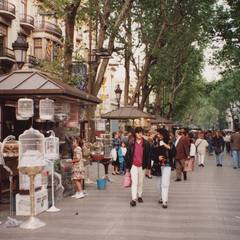 La RamblaThe tree-lined promenade from Plaça de Catalunya down to the sea, Barcelona’s busiest street.
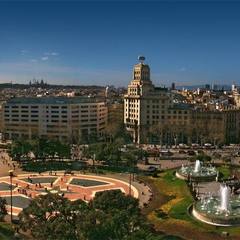 Plaça de CatalunyaThe great square where the old town meets the 19th-century Eixample.
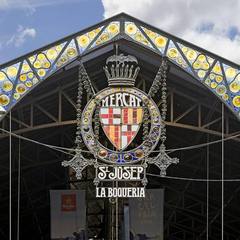 La BoqueriaBarcelona’s most famous market, under an iron roof just off the Rambla.
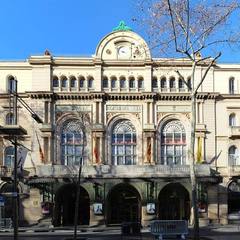 Gran Teatre del LiceuThe opera house on the Rambla, opened in 1847 and rebuilt after a fire in 1994.
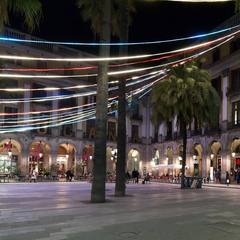 Plaça ReialAn arcaded square with palm trees and lamps designed by a young Antoni Gaudí.
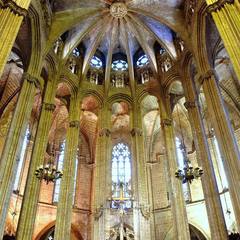 CathedralThe Gothic cathedral of Santa Eulàlia, with thirteen white geese in its cloister.
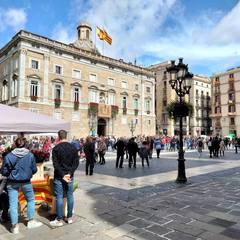 Plaça de Sant JaumeThe square where the government of Catalonia and the city hall face each other, on the old Roman forum.
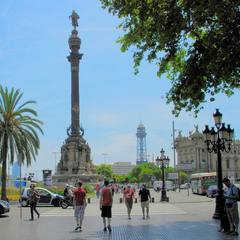 Columbus MonumentColumbus on a 60-metre column at the bottom of the Rambla, pointing out to sea.
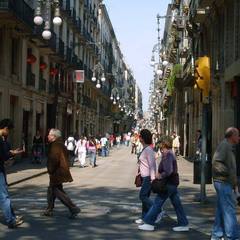 Gothic QuarterThe maze of narrow medieval lanes at the heart of the old town, on top of Roman Barcino.
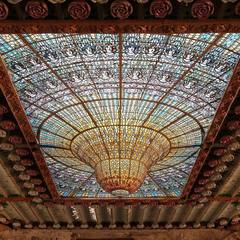 Palau de la Música CatalanaA concert hall of Catalan Modernism, all mosaic, stained glass and sculpture.
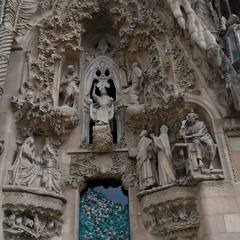 Sagrada FamíliaGaudí’s basilica, under construction since 1882; it lies beyond this small map, in the Eixample.
Also part of Barcelona

Streets, squares and waterways
The places that hold the centre of Barcelona together. Point at one to find it on the map.

-
1
Plaça de Catalunya square
The big square between the old town and the Eixample, where La Rambla, the Passeig de Gràcia and the metro lines meet.
-
2
La Rambla street
The tree-lined promenade from Plaça de Catalunya to the harbour, along the bed of a stream that once ran outside the medieval walls.
-
3
Portal de l’Àngel street
The busy pedestrian shopping street from Plaça de Catalunya towards the cathedral, named after a gate in the medieval walls.
-
4
Avinguda de la Catedral street
The broad open space in front of the cathedral, where people dance the sardana, the Catalan circle dance, at weekends.
-
5
Plaça del Rei square
The medieval square of the royal palace of the counts and kings, now part of the city’s history museum, with Roman Barcino excavated beneath it.
-
6
Gothic Quarter Barri Gòtic quarter
The oldest part of the city, on the site of Roman Barcino, a maze of narrow lanes between La Rambla and Via Laietana.
-
7
Carrer del Bisbe street
The lane from Plaça de Sant Jaume to the cathedral, crossed by a neo-Gothic bridge that was only built in 1928.
-
8
Plaça de Sant Jaume square
The square where the Palau de la Generalitat, the seat of the Catalan government, faces the city hall across the old Roman forum.
-
9
Plaça Reial square
An arcaded square of the 1840s off La Rambla, with palm trees and lamp posts designed by the young Gaudí.
-
10
El Raval quarter
The old town west of La Rambla, whose name means suburb. Convents and hospitals filled it first, then textile mills, and today it is the most mixed district of the city.
-
11
Via Laietana street
The straight avenue that the city cut through the old town from 1908, from the harbour to the Eixample.
-
12
Passeig del Born street
The long, narrow square between Santa Maria del Mar and the old Born market, where the city held jousts and fairs in the Middle Ages.
-
13
Plaça del Portal de la Pau square
The square at the bottom of La Rambla, by the harbour, where the Columbus Monument points out to sea.
-
14
The Old Harbour Port Vell waterway
Barcelona’s old harbour at the foot of La Rambla, where a wooden walkway, the Rambla de Mar, crosses to the Maremàgnum and the aquarium.
-
15
Sagrada Família building
Gaudí’s great basilica in the Eixample, begun in 1882 and still being built, about two kilometres north of the old town.