
Madrid › About the city
This is Madrid
Madrid is the capital of Spain and its largest city, high on the plateau in the middle of the country. Philip II made it the seat of his court in 1561, and the kings who followed left it a royal palace, the arcaded Plaza Mayor and the Prado, one of the great art museums of the world. Today Madrid is also known for its late nights, its tapas bars and its football.
Photo: Matt Joseph, CC BY-SA 4.0, via Wikimedia Commons

Madrid at a glance
- Country
- Spain
- Autonomous community
- Community of Madrid
- Population
- About 3.4 million (city), almost 7 million (metropolitan area)
- Founded
- 9th century, as the Moorish fortress of Mayrit
- River
- The Manzanares
- Language
- Spanish
- Nickname
- Villa y Corte (town and court)
- UNESCO World Heritage
- The Paseo del Prado and the Buen Retiro park, since 2021
Known for
- The Prado, the Reina Sofía with Picasso’s Guernica, and the Thyssen museum
- The Royal Palace, the Plaza Mayor and the Puerta del Sol
- Real Madrid and Atlético de Madrid
- Late dinners, tapas, churros with chocolate and the Sunday flea market of El Rastro
The city
Madrid lies about 650 metres above sea level, almost in the geographical centre of Spain, and all the country’s main roads are measured from a plaque in the Puerta del Sol. It is a young capital by European standards: a small town until the king’s court arrived in the 16th century, it grew around the palace into a city of grand avenues, museums and parks.
The old town, the part you ride through in Instant Madrid, is the Madrid de los Austrias, the city of the Habsburg kings. From the Puerta del Sol the Calle Mayor runs west past the Plaza Mayor and the Plaza de la Villa towards the Royal Palace and the cathedral on the bluff above the river. The Gran Vía crosses the north of the centre on its way to the Plaza de España, La Latina and its taverns lie to the south, and the Barrio de las Letras, the quarter of the writers, lies to the east.
Where it lies
Madrid lies in the middle of the Iberian Peninsula, on the high plateau of the Meseta, and is the capital of the autonomous community of the same name. The Sierra de Guadarrama, often white with snow in winter, rises some 50 kilometres to the north-west. The Manzanares, a small river, flows past the west side of the old town; its banks, where the ring road now runs in tunnels, became the long park of Madrid Río in 2011.
The climate is dry, with hot summers and cold, sunny winters. The great parks, the Retiro in the east and the Casa de Campo across the river, give the city its green spaces.
Places and landmarks
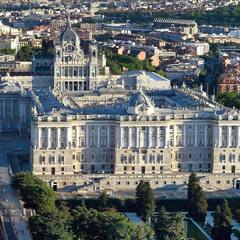 Royal PalaceWith more than 3,000 rooms the largest royal palace in western Europe, still used for state occasions.
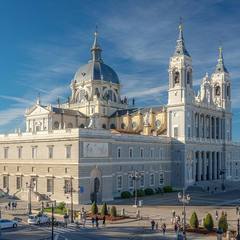 Almudena CathedralMadrid’s cathedral, begun in 1883 and only consecrated in 1993, facing the Royal Palace.
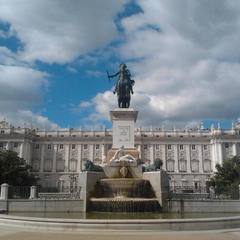 Plaza de OrienteThe gardens between the Royal Palace and the opera, with a famous statue of Philip IV on a rearing horse.
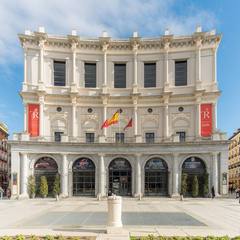 Teatro RealMadrid’s opera house, facing the Royal Palace across the Plaza de Oriente.
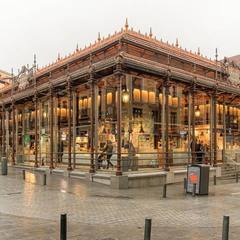 Mercado de San MiguelAn iron-and-glass market hall of 1916, now a gourmet food hall next to the Plaza Mayor.
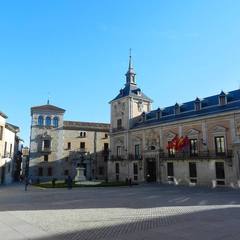 Plaza de la VillaA small square of three buildings from three centuries, the old heart of Madrid’s government.
The centre on a map
The streets, squares and waterways every visitor to Madrid ends up in. Point at one to find it on the map.

-
1
Puerta del Sol square
Madrid’s busiest square, with kilometre zero of Spain’s roads and the clock that rings in the New Year.
-
2
Calle de Preciados street
The pedestrian shopping street from the Puerta del Sol up to Callao, lined with department stores.
-
3
Plaza de Callao square
The square on the Gran Vía of cinemas and neon signs, among them the Schweppes sign on the Carrión building.
-
4
Gran Vía street
The grand avenue cut through the old town from 1910, with banks, theatres, hotels and some of Europe’s first tall buildings.
-
5
Plaza de España square
The big square at the end of the Gran Vía, with a monument to Cervantes and his Don Quixote and Sancho Panza, reopened in 2021 after a rebuild that gave more of it to gardens and walkers.
-
6
Calle del Arenal street
The street from the Puerta del Sol to the opera, named after the sandy bed of a stream that once ran along it.
-
7
Plaza de Oriente square
The gardens between the Royal Palace and the opera house, lined with statues of Spanish kings.
-
8
Calle de Bailén street
The street along the Royal Palace and the cathedral, named after a Spanish victory over Napoleon’s army in 1808, which crosses the Calle de Segovia on a viaduct.
-
9
Calle Mayor street
The old high street of Madrid, from the Puerta del Sol west towards the palace, the route of royal processions.
-
10
Plaza de la Villa square
A small square off the Calle Mayor with buildings from three centuries, where the city council met until 2007.
-
11
Plaza Mayor square
The arcaded square of 1619, once the stage for markets, bullfights and the trials of the Inquisition.
-
12
Calle de la Cava Baja street
The street of taverns and tapas bars in La Latina, which follows the ditch outside the medieval walls.
-
13
Plaza de Santa Ana square
The square of bars and terraces in the Barrio de las Letras, in front of the Teatro Español.
-
14
Calle de las Huertas street
The main street of the Barrio de las Letras, where Cervantes and Lope de Vega lived, with lines of their work set in bronze letters in the pavement.
-
15
Carrera de San Jerónimo street
The street from the Puerta del Sol down to the Paseo del Prado, past the Congress of Deputies with its bronze lions.
History
Mayrit and the Castilian town
In the 9th century Muhammad I, the emir of Córdoba, built a fortress on the bluff above the Manzanares to guard the road to Toledo against the Christian kingdoms of the north. The Arabs called the place Mayrit, after its streams; a stretch of its wall still stands below the cathedral, by the Cuesta de la Vega.
Alfonso VI of Castile took Madrid in 1085, around the time that he took Toledo. For almost five centuries it remained a modest Castilian town of farmers and craftsmen, where the kings sometimes stayed and the parliament, the Cortes, sometimes met. Its patron saint, Isidore, was a farmhand who worked the fields outside the town.
The court of the kings
In 1561 Philip II moved his court to Madrid, and apart from a few years in Valladolid at the start of the next century it has stayed there ever since. The town grew fast. In the 17th century, Spain’s Golden Age, Cervantes, Lope de Vega and Quevedo wrote in the streets east of the Puerta del Sol, Velázquez painted for the king, and in 1619 the Plaza Mayor was finished.
When the old Alcázar burned on Christmas Eve 1734, the Bourbon king Philip V ordered the stone palace that stands today. His son Charles III, often called Madrid’s best mayor, paved and lit the streets, built the Puerta de Alcalá and planned the building that became the Prado. On 2 May 1808 the people of Madrid rose against Napoleon’s troops, a day that Goya painted, and that began the Peninsular War.
The modern capital
In the 19th century Madrid outgrew its old boundaries, and new districts such as Salamanca rose on a grid to the north and east. From 1910 the city cut the Gran Vía through the old town, and in 1919 the first metro line opened. In the Spanish Civil War Madrid held out for the Republic through a siege of more than two years, until Franco’s troops entered in March 1939.
After Franco’s death in 1975 Madrid became the capital of a democracy and, in the 1980s, the scene of the Movida, a burst of music, film and nightlife. On 11 March 2004 bombs on commuter trains killed nearly 200 people. Today Madrid is Spain’s political and financial centre and one of the largest cities in the European Union.
Madrid today
Madrid is the seat of the king, the government and the parliament, whose lower house, the Congreso de los Diputados, stands on the Carrera de San Jerónimo. Many of Spain’s largest companies and banks have their headquarters here, and along the Paseo del Prado the Prado, the Reina Sofía and the Thyssen-Bornemisza museums lie within a short walk of each other.
Madrileños eat late and spend their evenings outside, on the terraces of the squares and in the tapas bars of La Latina and Huertas. On Sunday mornings the Rastro flea market fills the streets south of La Latina, and in mid-May the city celebrates its patron, San Isidro. Real Madrid plays at the Santiago Bernabéu, Atlético de Madrid at the Metropolitano.
Read on
- esMADRID The city’s official tourist information
- Ayuntamiento de Madrid The city council (in Spanish)
- Patrimonio Nacional Tickets and opening hours for the Royal Palace
- Paseo del Prado and Buen Retiro on UNESCO The World Heritage listing
- Madrid on Wikipedia The encyclopedia article