
New York › About the city
This is New York
New York lies at the mouth of the Hudson River on the Atlantic coast of the United States, a city of five boroughs on islands and the shore round one of the world’s great natural harbours. Manhattan, the long island at its heart, is a grid of avenues and numbered streets lined with skyscrapers. The Dutch founded it as New Amsterdam, millions of immigrants came in through its harbour, and today it is the largest city of the United States and a world capital of money, theatre, art and fashion.
Photo: Dllu, CC BY-SA 4.0, via Wikimedia Commons

New York at a glance
- Country
- The United States
- State
- New York
- Population
- About 8.5 million (city), about 20 million in the metropolitan area
- Boroughs
- Manhattan, Brooklyn, Queens, the Bronx and Staten Island
- Lies
- At the mouth of the Hudson, on the Atlantic; about 330 km north-east of Washington
- Height
- From sea level to about 125 m; Midtown lies about 15 to 30 m up
- Language
- English, and hundreds more spoken in its homes
- Known for
- Skyscrapers, Broadway, the Statue of Liberty, Wall Street
Known for
- The skyline of Manhattan, with the Empire State and Chrysler Buildings
- Times Square and the theatres of Broadway
- The Statue of Liberty in the harbour
- Central Park
- Yellow cabs and the subway that runs all night
- Wall Street, and pizza by the slice
The city
Manhattan is an island about 21 kilometres long and at most 4 wide, between the Hudson River and the East River. In 1811 the city laid a grid over it: twelve avenues running north and south, and numbered streets crossing them from east to west, with only Broadway, the old Indian trail, running across at a slant. Downtown, at the southern tip, is the old city and Wall Street; Midtown, between about 34th and 59th Street, is the second business district, the one with the tallest towers and most of the sights; Central Park lies to the north of it.
Instant New York takes you round Midtown: down Seventh Avenue through Times Square, along 34th Street to the Empire State Building, up Fifth Avenue past the Public Library and Bryant Park, along 42nd Street past Grand Central to the Chrysler Building, and back along 49th Street by Rockefeller Center. In the game, as in the real city, most of the cars are yellow cabs, and most of the avenues are one-way.
Where it lies
New York grew round its harbour, where the Hudson meets the Atlantic, sheltered behind Staten Island and Long Island. Only the Bronx lies on the mainland; Manhattan and Staten Island are islands, and Brooklyn and Queens lie on the west end of Long Island. Hundreds of bridges and tunnels tie them together, and Manhattan’s hard bedrock is what lets its skyscrapers stand so tall and so close.
The climate is one of hot, humid summers and cold winters, with snowstorms now and then that bring the city to a halt. Rain falls in every season, and in late summer and autumn the tail of a hurricane sometimes reaches it.
Places and landmarks
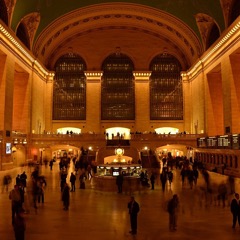 Grand Central TerminalThe great railway station on 42nd Street, with its hall under a ceiling of stars and its clock of opal.
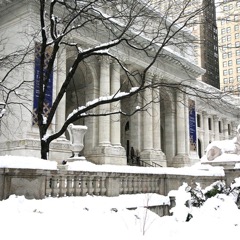 New York Public LibraryThe marble library on Fifth Avenue, guarded by the two stone lions Patience and Fortitude.
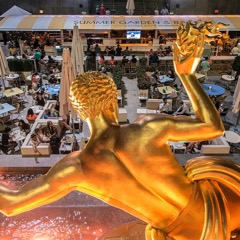 Rockefeller CenterThe Art Deco towers between Fifth and Sixth Avenue, with the golden Prometheus, the skating rink and the Christmas tree.
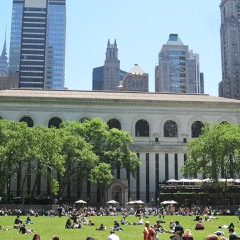 Bryant ParkThe green lawn behind the Public Library, with its plane trees, its green chairs and in winter its ice rink.
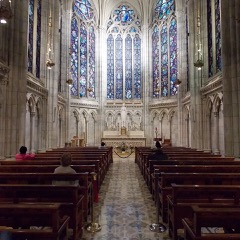 St. Patrick’s CathedralThe Gothic cathedral of white marble on Fifth Avenue, facing Rockefeller Center.
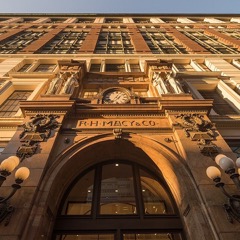 Macy’s Herald SquareOne of the largest department stores in the world, on 34th Street, where the Thanksgiving Day Parade ends.
The centre on a map
The streets, squares and waterways every visitor to New York ends up in. Point at one to find it on the map.

-
1
Times Square square
The crossing of Broadway and Seventh Avenue, under its walls of screens.
-
2
Broadway street
The old trail that cuts across the grid at a slant, through the Theater District.
-
3
Seventh Avenue street
The avenue through Times Square and the Garment District, one-way to the south.
-
4
Fifth Avenue street
The grand avenue of shops, the library and the cathedral, one-way to the south.
-
5
42nd Street street
The wide crosstown street from Times Square past Grand Central to the Chrysler Building.
-
6
Empire State Building building
The Art Deco tower of 1931 on 34th Street, 443 metres to the top of its mast.
-
7
Herald Square square
The triangle where Broadway crosses Sixth Avenue, in front of Macy’s.
-
8
Morgan Library building
The banker J. P. Morgan’s library of old books and manuscripts, on Madison Avenue.
-
9
Bryant Park park
The lawn behind the library, with green chairs and a winter ice rink.
-
10
New York Public Library building
The marble library of 1911, with its two stone lions.
-
11
Grand Central Terminal building
The station of 1913, with its hall under a ceiling of stars.
-
12
Chrysler Building building
The Art Deco tower with a crown of steel arches.
-
13
Park Avenue street
The avenue built over the railway tracks out of Grand Central, lined with office towers.
-
14
Diamond District quarter
The block of 47th Street where most of America’s diamonds are traded.
-
15
Rockefeller Center building
The Art Deco towers round the plaza with the skating rink.
-
16
St. Patrick’s Cathedral building
The Gothic cathedral on Fifth Avenue, facing Rockefeller Center.
-
17
Radio City Music Hall building
The Art Deco theatre of 1932, home of the Rockettes.
History
New Amsterdam
The Lenape people lived on the island they called Mannahatta when Giovanni da Verrazzano sailed into the harbour in 1524 and Henry Hudson sailed up the river in 1609. The Dutch West India Company set up a trading post here in 1624, and two years later Peter Minuit is said to have bought Manhattan from the Lenape for goods worth 60 guilders.
New Amsterdam grew round a fort at the southern tip, with a wall across the island where Wall Street runs today. In 1664 an English fleet took it without a fight, and it was renamed New York after the Duke of York.
The port of a continent
After the War of Independence New York was briefly the capital of the United States, and George Washington took his oath as the first president on Wall Street in 1789. In 1811 the city laid out the grid of streets that would cover Manhattan, long before the houses reached that far north.
The Erie Canal, opened in 1825, linked the harbour with the Great Lakes, and New York became the biggest port of America. Millions of immigrants from Ireland, Germany, Italy and Eastern Europe came in through it, from 1892 through Ellis Island, and crowded into the tenements of the Lower East Side.
Greater New York
In 1898 Manhattan, Brooklyn, Queens, the Bronx and Staten Island joined into one city. The first subway line opened in 1904, Grand Central Terminal in 1913, and the city grew upwards: the Woolworth Building, the Chrysler Building and in 1931 the Empire State Building were each the tallest building in the world.
After the Second World War the United Nations made its home on the East River, and New York became the centre of the art world and of finance. In the 1970s the city nearly went bankrupt and many of its streets were run down, but it recovered in the 1990s.
Since 2001
On 11 September 2001 terrorists flew two planes into the twin towers of the World Trade Center, which collapsed, killing nearly 3,000 people. One World Trade Center, the tallest building in the Western Hemisphere, opened on the site in 2014.
Since then the city has given more of its streets back to people on foot and on bikes: Broadway through Times Square was closed to cars in 2009, bike lanes run along the avenues, and old railway lines and piers have become parks, such as the High Line on the West Side.
New York today
New York is the largest city of the United States, with about 8.5 million people, more than a third of them born abroad. Wall Street and Midtown are home to banks, the stock exchanges, the big media companies and the headquarters of the United Nations, and the subway carries millions of people a day, all night long.
Visitors come for the view from the Empire State Building and the Top of the Rock, the museums on Fifth Avenue, the shows of Broadway, the lights of Times Square, Central Park and the ferry to the Statue of Liberty. In Midtown the streets are full from morning to midnight: office workers, tourists, food carts on the corners and yellow cabs honking in the traffic.
Read on
- NYC Tourism + Conventions The city’s official tourist site
- Empire State Building Tickets for the observatories
- New York Public Library The library on Fifth Avenue and its exhibitions
- New York City on Wikipedia The encyclopedia article