The town, street by street
About 1,100 houses and shops along the streets of the excavation, with the Via dell'Abbondanza, the Via Stabiana and the Via del Foro, paved with basalt blocks.
 Instant Cities
Walk or race through the Roman streets of Pompeii, with Vesuvius behind.
The streets of the town as the excavation maps them, the Forum with the Temple of Jupiter, the baths and the houses, and the amphitheatre at the east end.
Free · no account · works on PC, tablet and phone
About 1,100 houses and shops along the streets of the excavation, with the Via dell'Abbondanza, the Via Stabiana and the Via del Foro, paved with basalt blocks.
The Forum's two colonnades with the Temple of Jupiter at its end, and the amphitheatre, the oldest stone one there is, are modelled by hand. Vesuvius stands on the horizon where it really is.
A loop of about a kilometre from the Forum along the Via dell'Abbondanza and back by the Via Stabiana and the Via della Fortuna.
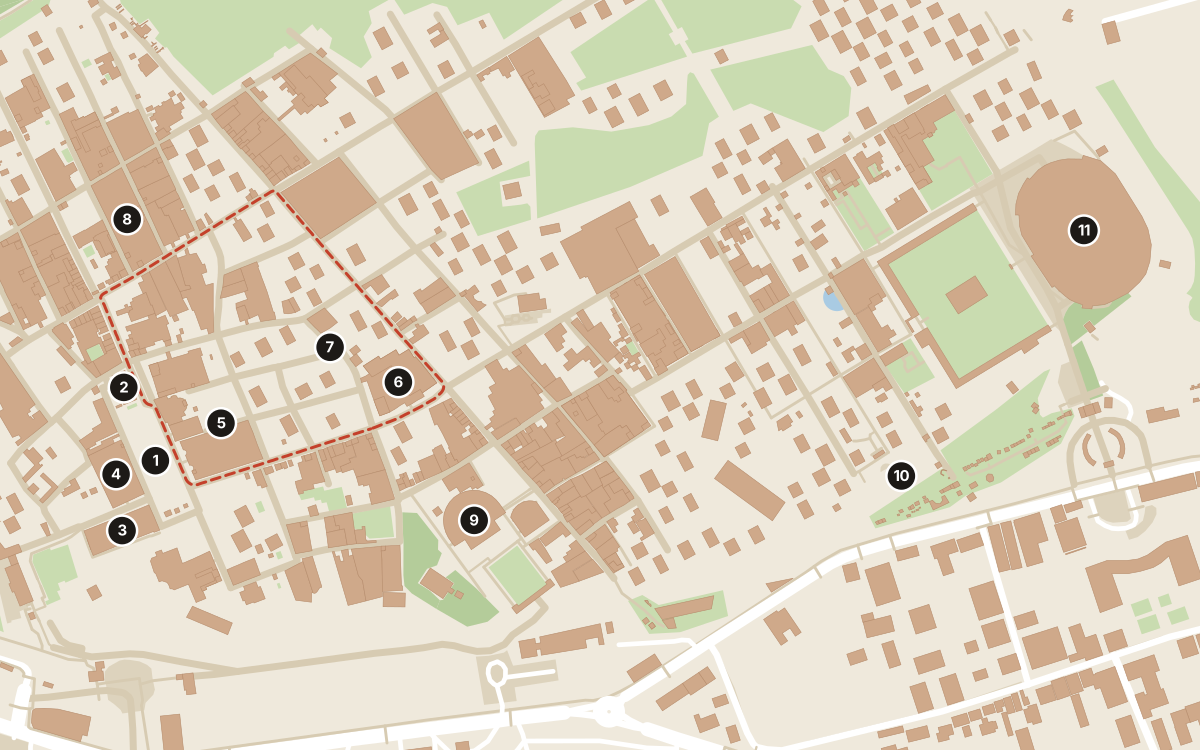
The square at the middle of Pompeii, 140 metres long, closed to carts. Temples, the basilica, the market and the offices of the town stood round it, and people came to trade, vote and hear the news.
The main temple of the town, at the north end of the Forum, built for Jupiter, Juno and Minerva. Vesuvius stands right behind it. An earthquake in AD 62 had already damaged it, and it was still being repaired in AD 79.
The law court and exchange, on the south-west corner of the Forum, about 150 BC. It is the oldest basilica we know of, and one of the biggest buildings in town.
The oldest temple in Pompeii, from the 6th century BC, standing in a court with a colonnade of 48 columns. Apollo was the town’s protector. The statues here are copies.
Streets ran with rainwater and rubbish, so there are blocks of lava to cross on. The gaps between them are as wide as a cart’s wheels, and you can still see the ruts the carts cut in the paving.
The oldest public baths in Pompeii, with a gymnasium, a swimming pool and rooms of different heat. Most citizens went most days, and the stucco ceilings are still there.
A small two-floor brothel with ten rooms, the best known of the town’s many. Its stone beds and the pictures and graffiti on its walls are still there.
The biggest house in Pompeii, filling a whole block, with two atria and two gardens. A small bronze faun dances in its pool. The huge mosaic of Alexander the Great in battle was found here.
A Greek-style theatre cut into the hillside in the 2nd century BC, for about 5,000 people. The smaller Odeon beside it was roofed, for concerts and readings.
Thirteen people, children among them, died in this garden under the ash. Their bodies rotted away and left hollows in the ash, which had set hard. In 1863 Giuseppe Fiorelli had plaster poured into the hollows, and the casts show the people as they lay. More are in the Forum Granaries.
Built about 70 BC, the oldest stone amphitheatre there is, for some 20,000 people. In AD 59 a fight between the fans of Pompeii and Nuceria here ended in a riot, and Rome shut the arena for ten years.
Still in development: expect some rough edges.