
Copenhagen › Places and landmarks
Places and landmarks in Copenhagen
12 landmarks of Copenhagen, and the streets, squares and waterways around them, each with its story and where to find it.
Landmarks
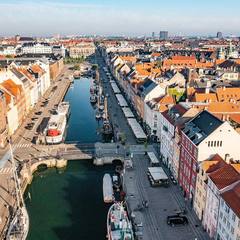 NyhavnThe 17th-century harbour of coloured houses, wooden ships and café terraces.
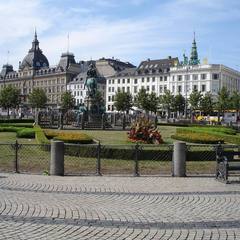 Kongens NytorvThe King’s New Square, with the Royal Danish Theatre and a bronze king on horseback.
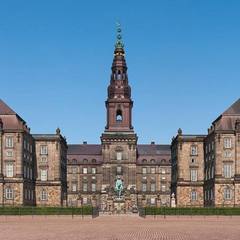 ChristiansborgThe palace on Slotsholmen that holds the parliament, the prime minister’s office and the supreme court.
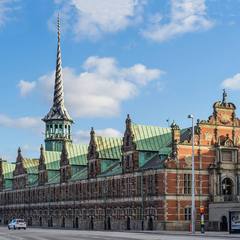 BørsenChristian IV’s stock exchange of 1640, with a spire of four dragons’ tails, burned in 2024.
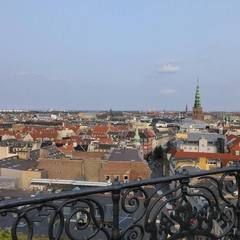 Round TowerChristian IV’s observatory of 1642, climbed by a spiral ramp instead of stairs.
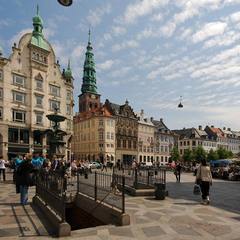 StrøgetOne of the longest pedestrian shopping streets in Europe, from the City Hall Square to Kongens Nytorv.
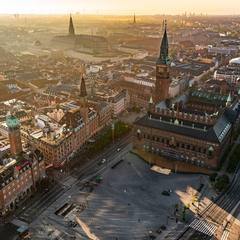 City Hall SquareThe square in front of Copenhagen’s red-brick city hall, with its 105-metre tower.
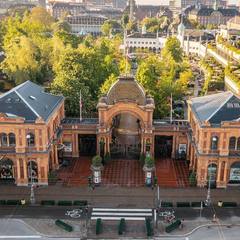 TivoliOne of the oldest amusement parks in the world, opened in 1843 in the middle of the city.
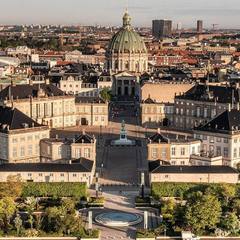 AmalienborgFour identical rococo palaces round an octagonal square, home of the Danish royal family.
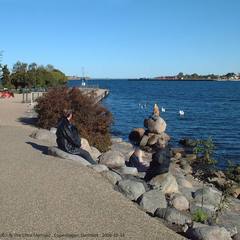 The Little MermaidEdvard Eriksen’s statue of Andersen’s mermaid on a rock by the harbour, beyond this small map.
Also part of Copenhagen

Streets, squares and waterways
The places that hold the centre of Copenhagen together. Point at one to find it on the map.

-
1
City Hall Square Rådhuspladsen square
The big square in front of the red-brick City Hall of 1905, where Strøget begins. Tivoli lies across the boulevard.
-
2
Tivoli Gardens Tivoli park
The pleasure garden that opened in 1843 beside the old city moat, now a lake inside it, with rides, concerts and thousands of lights in the evening.
-
3
Strøget street
The chain of pedestrian streets from City Hall Square to Kongens Nytorv. The city closed it to cars in 1962, which made it one of the first long pedestrian streets in Europe.
-
4
Gammeltorv square
Copenhagen’s oldest square, on Strøget, with the Caritas Fountain of 1608. The old courthouse stands on Nytorv next to it.
-
5
Gråbrødretorv square
A small cobbled square on the site of a Franciscan friary, the Grey Friars, lined with colourful old houses and restaurant terraces.
-
6
Købmagergade street
A pedestrian street running north from Strøget past the Round Tower, the observatory that Christian IV built with a spiral ramp in place of stairs.
-
7
Amagertorv square
The widest stretch of Strøget, with the Stork Fountain, named after the farmers from Amager who sold their produce here.
-
8
Højbro Plads square
The square at the end of Strøget facing Slotsholmen, with an equestrian statue of Bishop Absalon, the founder of the city.
-
9
Gammel Strand street
The old shoreline across the canal from Christiansborg, where fishwives once sold the catch and canal boats leave today.
-
10
Slotsholmen quarter
The island where Absalon built his castle, now home to Christiansborg Palace and the old stock exchange, Børsen.
-
11
Kongens Nytorv square
The city’s largest square, laid out under Christian V in the 1670s, with his equestrian statue in the middle and the Royal Danish Theatre beside it.
-
12
Nyhavn waterway
The canal dug from Kongens Nytorv to the harbour in the 1670s, lined with brightly painted houses and old wooden ships. Hans Christian Andersen lived in three of its houses.
-
13
Bredgade street
The broad main street of Frederiksstaden, running north from Kongens Nytorv past the Marble Church to the Design Museum.
-
14
Amalienborg Palace Square Amalienborg Slotsplads square
The octagonal square of four matching palaces, home to the royal family since 1794, with Frederik V on horseback in the middle. The guard changes here every day at noon.
-
15
Christianshavn Canal Christianshavns Kanal waterway
The canal through Christianshavn, the district across the harbour that Christian IV laid out on reclaimed land from 1619, on the model of Amsterdam.